

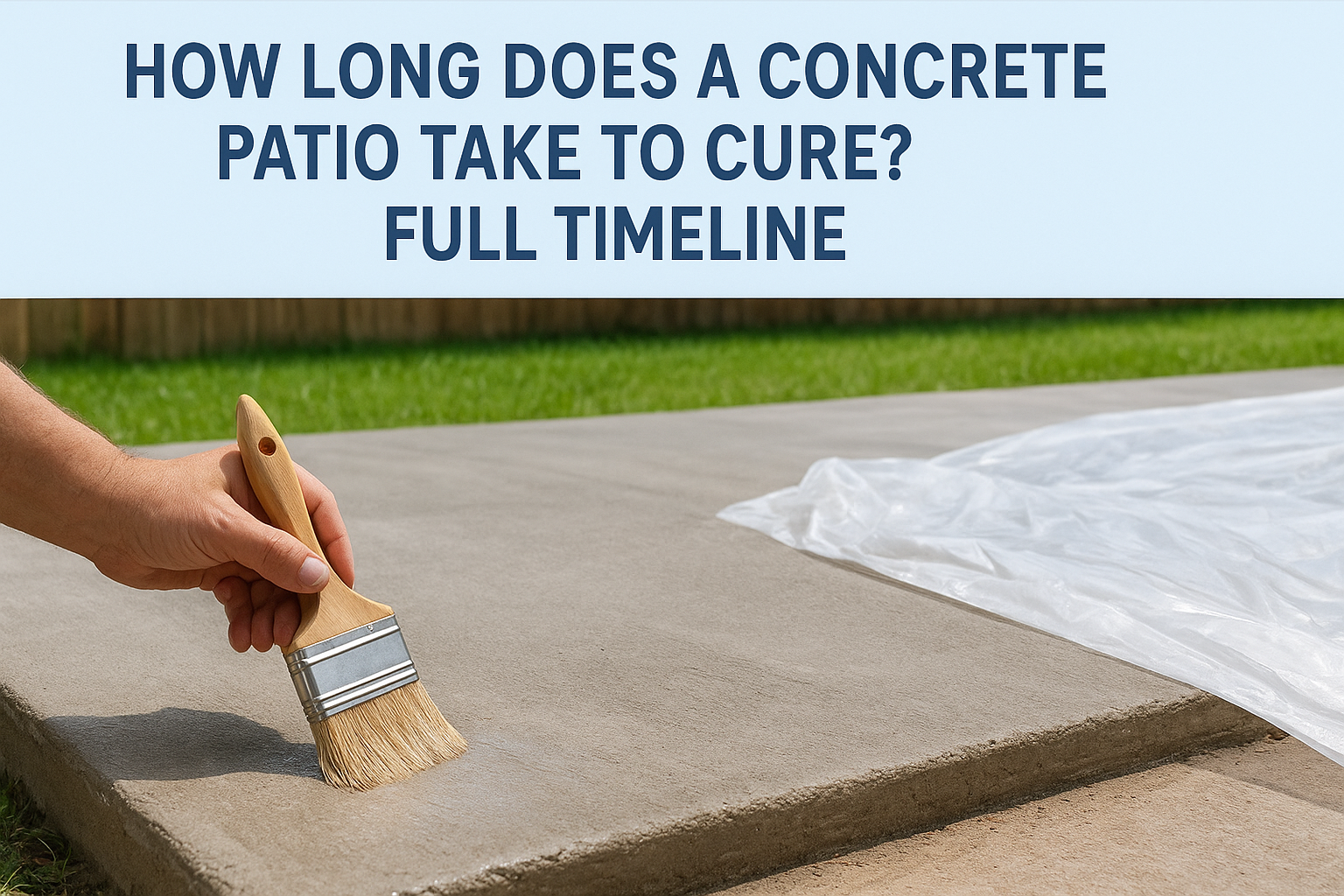
You just had a new patio poured, now comes the hard part: waiting. One of the most common questions we hear at CHC Concrete is how long does a concrete patio take to cure, and the honest answer is that it depends on several factors specific to your project and location. Rush the process, and you risk permanent surface damage like cracking, scaling, or weak spots that shorten the life of your slab.
Here in Southwest Florida, curing doesn’t follow the same rules as it does up north. Our intense UV exposure, high humidity, and sudden afternoon downpours all affect how concrete sets and gains strength. At CHC Concrete, we’ve poured and finished patios across Fort Myers, Cape Coral, Estero, and Bonita Springs, and we’ve seen firsthand what happens when curing timelines get ignored or when homeowners get bad advice about when it’s safe to start using their new surface. It’s not just about a number of days; it’s about understanding what’s actually happening inside the slab at each stage.
This article breaks down the full curing timeline from the first 24 hours through the 28-day mark, covers when you can walk on your patio, when furniture can go back, and what local conditions in Southwest Florida mean for your specific pour. No guesswork, just a clear, practical schedule you can follow with confidence.
What curing means and why it matters
Most people assume that curing and drying are the same thing. They’re not. Drying refers to water evaporating out of the concrete mix, but curing is a completely different process called hydration, where water chemically reacts with cement particles to form a hard, interlocking crystal structure. This is what gives your patio its strength, and it’s the reason how long a concrete patio takes to cure directly affects how long your slab will last.
The chemistry behind curing
When water and cement meet, they trigger a chemical reaction that produces calcium silicate hydrate, the compound responsible for binding the slab together. This reaction doesn’t happen instantly, and it doesn’t stop after a single day of setting up. The process continues over days and weeks, with your concrete gaining roughly 70% of its design strength within the first seven days, and reaching close to its full structural capacity around the 28-day mark.
Concrete that cures too fast loses moisture before the chemical reaction can fully develop, resulting in a weaker slab regardless of how solid the surface looks.
The rate at which this reaction unfolds depends heavily on temperature, humidity, and moisture retention. A slab that loses moisture too quickly through evaporation locks up before the internal structure can fully bind. That’s why contractors use curing compounds, wet burlap, or plastic sheeting to slow moisture loss and keep the reaction running at the right pace.
Why stopping early causes real damage
Cutting the curing period short doesn’t just make the concrete slightly weaker. It creates surface scaling, micro-cracks, and reduced freeze-thaw resistance, none of which are visible until months or years later when the damage becomes hard to reverse. In Southwest Florida, the combination of intense sun and rapid evaporation means surface moisture disappears faster than in most other climates, which makes proper curing practices even more critical here than in northern states.
Your slab also bears future loads, shifting soil, temperature expansion, and vehicle weight. Each of these stresses the concrete differently, and a slab that didn’t cure fully simply won’t handle them the same way as one that completed the process correctly.
Concrete patio curing timeline and use milestones
Understanding how long a concrete patio takes to cure means looking at the process in defined stages rather than treating it as one long wait. Your slab hits specific strength thresholds at predictable points, and each threshold tells you exactly what activity the surface can handle without causing damage.
The first 48 hours
The first 24 to 48 hours are the most sensitive period of the entire cure. Your slab looks solid, but the internal hydration reaction is still in early development, and any weight or pressure during this stage leaves permanent surface impressions that can’t be corrected without grinding or resurfacing later.
Keep all foot traffic off the slab for at least the first 24 hours. If your contractor applied a curing compound or laid plastic sheeting over the surface, leave it completely undisturbed, since removing it early disrupts moisture retention before the binding process can finish.
The surface hardening you see in the first day is not structural strength. Real strength builds over the next several weeks.
From week one to full cure
By day three, light foot traffic is generally acceptable, but you should still avoid dragging furniture or placing concentrated loads on any single spot. The table below gives you a practical reference from pour day through full cure.
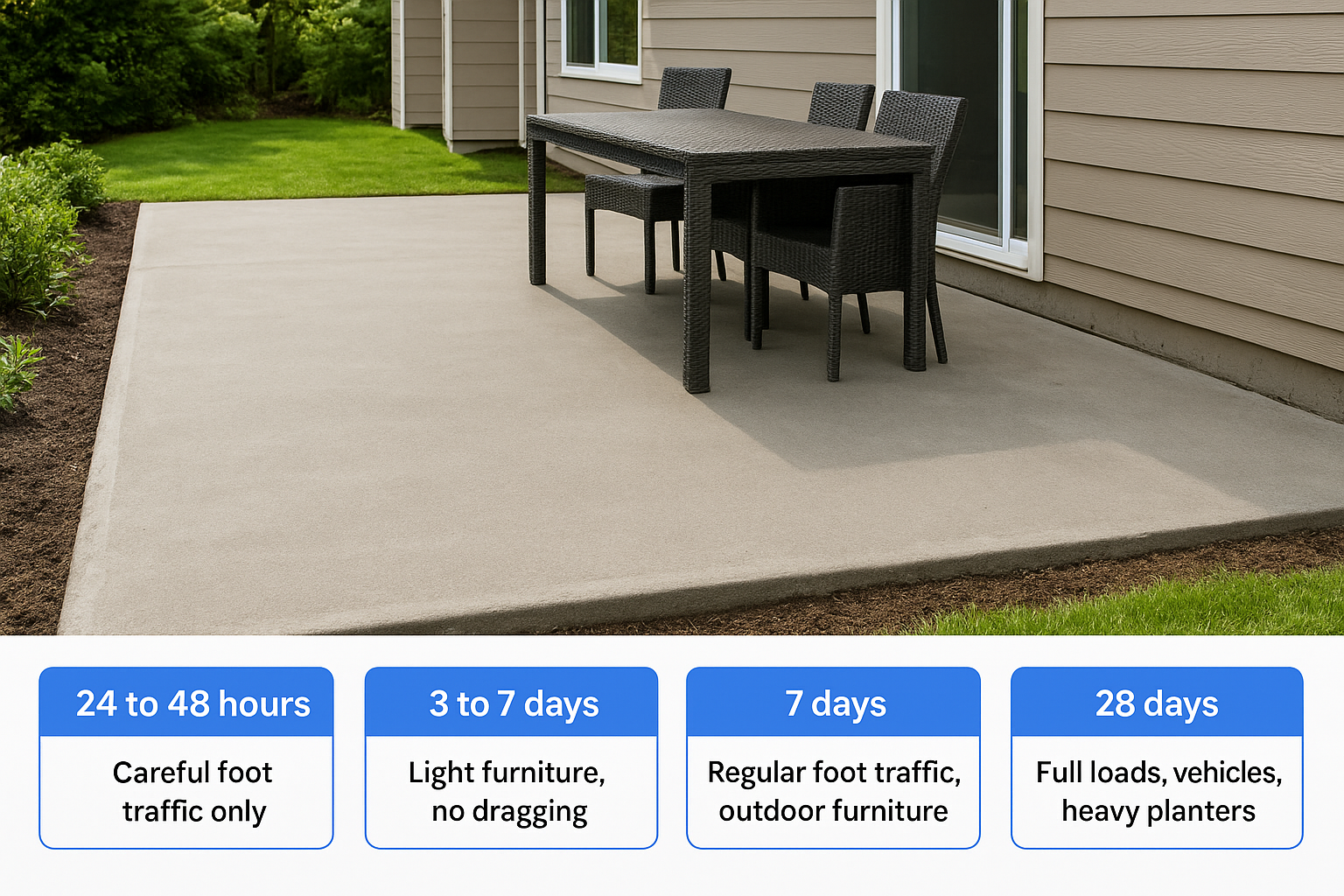
| Timeframe | Safe Activity |
|---|---|
| 24 to 48 hours | Careful foot traffic only |
| 3 to 7 days | Light furniture, no dragging |
| 7 days | Regular foot traffic, outdoor furniture |
| 28 days | Full loads, vehicles, heavy planters |
At day 28, your patio reaches its design strength and is ready for full use, including vehicles, heavy outdoor furniture, and large planters.
What changes curing time in Southwest Florida
Southwest Florida’s climate doesn’t follow the conditions most curing guidelines are written for. Temperature, UV intensity, and seasonal rainfall patterns all push your concrete through the curing stages differently than they would in a northern or inland climate, which means how long a concrete patio takes to cure here can shift more than most homeowners expect.
Heat and UV Exposure
High surface temperatures accelerate moisture evaporation, which works directly against the hydration process your slab needs to build strength. When your patio sits under direct Florida sun during a summer pour, the surface can dry out faster than the interior can cure, creating a strength gap between the top layer and the core. Contractors in Fort Myers and Cape Coral typically schedule pours for early morning to limit the direct sun exposure the fresh slab receives during its most vulnerable hours.
Afternoon heat in Southwest Florida can push surface temperatures 20 to 30 degrees higher than air temperature, which means even a mild-looking day can stress a fresh pour significantly more than the forecast suggests.
Unprotected concrete poured in peak summer sun can lose critical surface moisture within the first hour, before the hydration reaction reaches the depth it needs.
Humidity and Rainfall Timing
High ambient humidity slows evaporation slightly, which can actually support curing when managed correctly, but sudden heavy rain within the first 24 hours creates a serious problem. Rainfall on fresh concrete dilutes the surface cement paste, weakening the top layer and leaving you with a chalky, porous finish once the slab dries.
Checking the forecast before any pour is something every experienced contractor in Southwest Florida treats as a non-negotiable step, not an afterthought.
How to cure a patio the right way
Knowing how long a concrete patio takes to cure is only half the equation. What you do during those weeks actively determines the final strength of your slab. Proper curing is a set of deliberate actions, not just a waiting period, and following the right steps from day one keeps the hydration process running as it should.
Keep moisture in the slab
Your primary job during the cure is to prevent premature moisture loss. Your contractor should apply a liquid curing compound immediately after the finishing stage, or cover the slab with plastic sheeting or wet burlap to lock in the surface moisture the hydration reaction depends on. If you see the covering dry out or shift during the first few days, rewet it and reposition it right away.
Skipping a curing compound to save time or money is one of the most common reasons a patio surface fails within the first few years.
Wet curing methods, such as regularly misting the surface with water, are effective when applied consistently for the first seven days. Your goal is to keep the slab surface damp, not saturated, throughout this window.
Protect the surface from direct sun and traffic
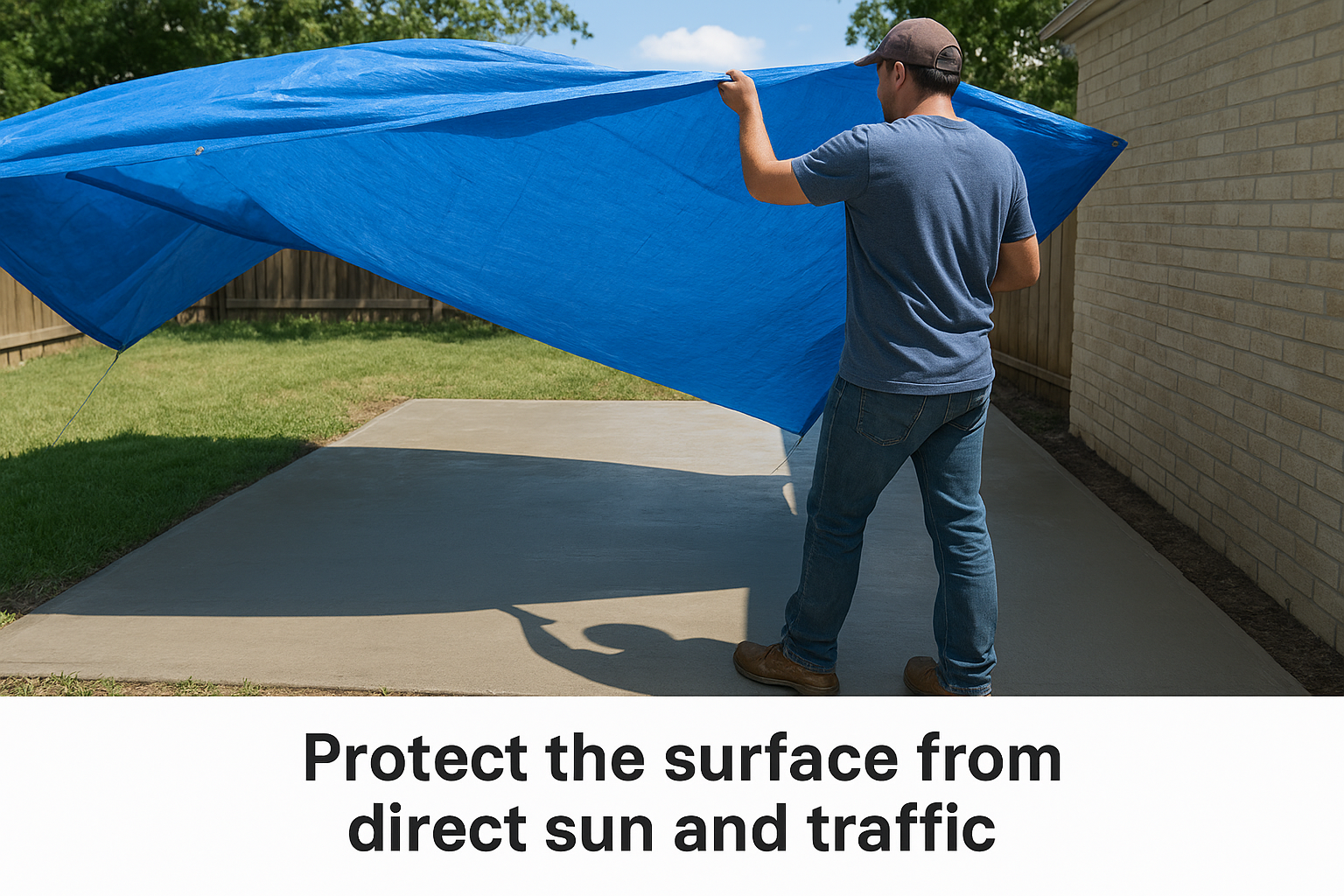
Shading your fresh patio with temporary tarps or shade cloth during peak afternoon hours dramatically reduces surface temperature and slows evaporation in the Southwest Florida heat. Keep all foot traffic and furniture completely off the slab for the first 24 hours, and follow the use milestones outlined earlier before adding any significant weight or load.
Common mistakes and quick troubleshooting
Even when you understand how long a concrete patio takes to cure, small decisions during those first few weeks can undo a well-executed pour. Most curing failures trace back to a handful of predictable and avoidable errors that homeowners make without realizing the impact until the damage shows up months later.
Mistakes that damage a fresh pour
The most frequent mistake is allowing foot traffic or furniture placement too early, typically within the first 24 hours when the surface feels firm but the internal structure is nowhere near ready for load. Another common error is letting your curing compound or plastic covering dry out and shift without replacing it, which leaves patches of the slab exposed to direct sun and rapid moisture loss. Watering your nearby lawn or garden too close to a fresh pour is also a problem, since oversaturation from sprinkler runoff can weaken the surface cement paste along the slab edge.
Concrete that looks cured on the surface can still be losing critical internal moisture, so always follow the milestone timeline rather than judging by appearance alone.
What to do when something goes wrong
If you notice surface cracking or a chalky white residue forming within the first week, the slab likely lost moisture too fast. Contact your contractor immediately rather than waiting, since early intervention gives you more repair options. For minor surface issues like small cracks or scaling patches, a concrete resurfacer applied after full cure at 28 days can restore the surface without a full replacement. Deeper structural cracking that develops before the 28-day mark almost always signals a base preparation or curing failure that needs professional assessment.
A quick wrap-up
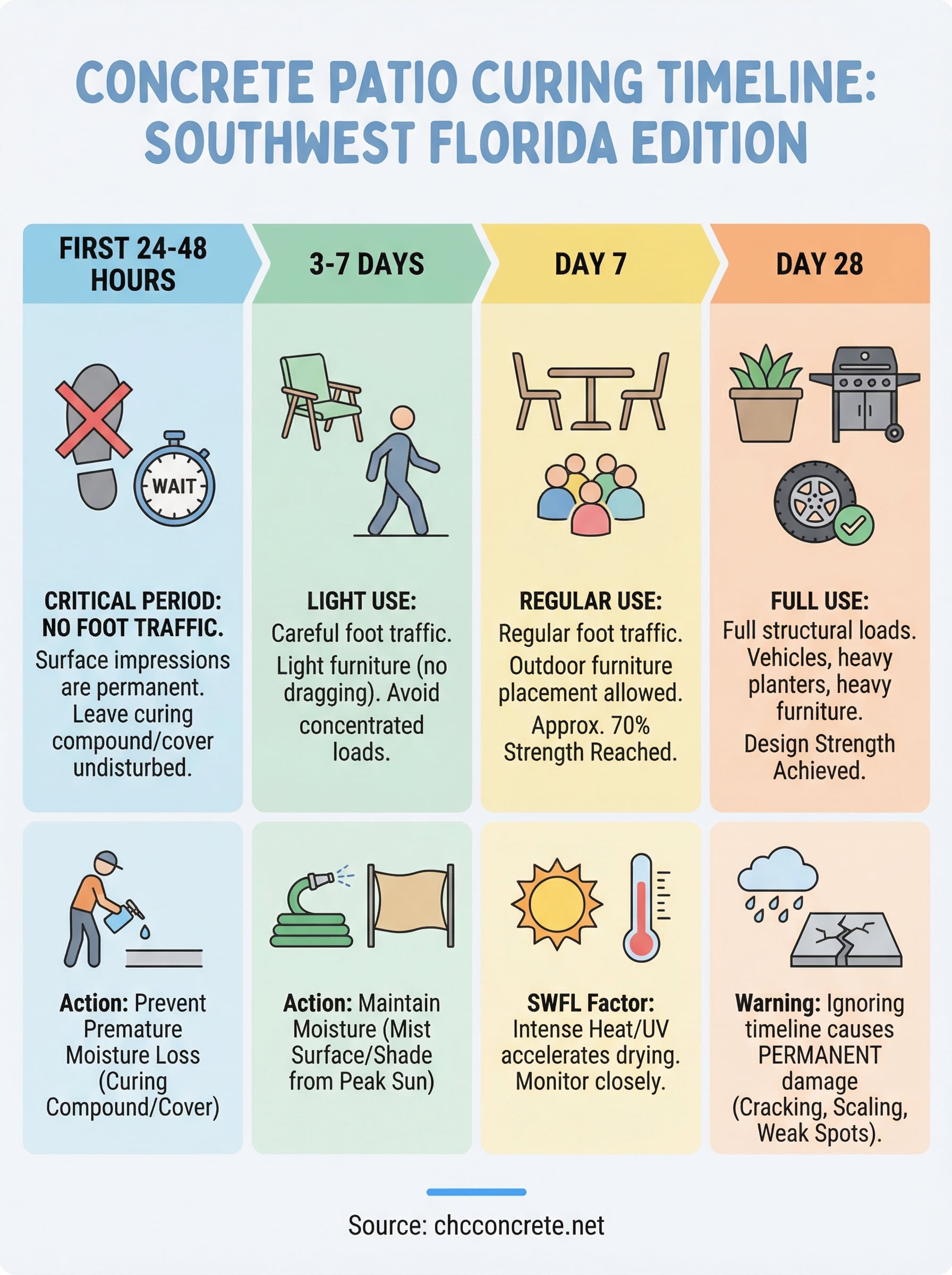
Understanding how long does a concrete patio take to cure gives you the knowledge to protect your investment from day one. The full process runs from no foot traffic in the first 24 hours through full structural loads at the 28-day mark, with clear milestones in between that tell you exactly what your slab can handle at each stage. Southwest Florida’s heat, UV intensity, and seasonal rain add pressure to every pour, which makes following a deliberate curing plan more critical here than in most other regions.
Your decisions during those first four weeks directly determine how your patio performs over the next decade. Keeping moisture in the slab, shading fresh concrete from peak afternoon sun, and respecting the use timeline are the three actions that separate a long-lasting surface from one that cracks and scales prematurely. Ready to get your project done right from the start? Request a free estimate from CHC Concrete and work with a crew that takes curing seriously.