


Your driveway is cracked, pitting, or just plain ugly, but does that mean you need to rip the whole thing out and start over? Not necessarily. Understanding concrete driveway resurfacing cost before you commit to a project helps you avoid overspending on a full replacement when a resurface might be all you need. In most cases, resurfacing runs $3 to $10 per square foot, though that number shifts depending on the condition of your existing slab, the finish you choose, and where you live.
Here in Southwest Florida, we see driveways take a beating from UV exposure, tropical rain cycles, and sandy soil movement. At CHC Concrete, we resurface and repair driveways across Fort Myers, Cape Coral, Estero, and Bonita Springs, so we know exactly where local pricing falls and what drives those numbers up or down. We built this guide from that hands-on experience, not recycled national data.
Below, you’ll find a full breakdown of 2026 resurfacing costs per square foot, the factors that affect your final price, and a direct comparison between resurfacing and full replacement. By the end, you’ll have a clear picture of what your project should cost, and whether resurfacing is the right move for your property.
Average concrete driveway resurfacing cost in 2026
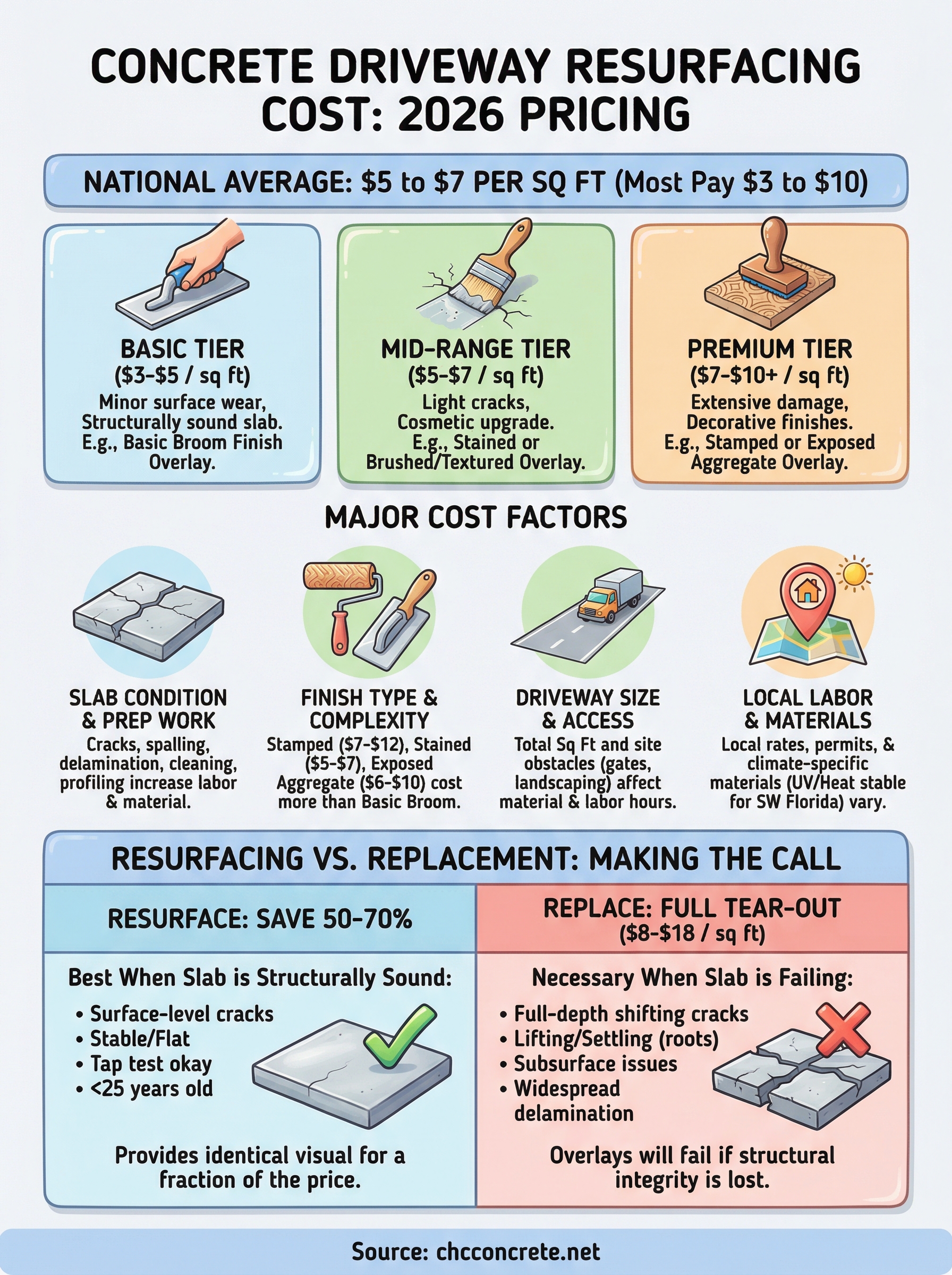
In 2026, most homeowners pay between $3 and $10 per square foot for concrete driveway resurfacing, with the national average landing around $5 to $7 per square foot for a standard overlay on a slab in decent condition. The wide range exists because resurfacing isn’t one product or one process. A basic skim coat on a sound slab sits at the low end. A stamped or stained decorative overlay with crack repair work sits at the high end. Your final number depends on the finish type, slab condition, prep requirements, and local labor rates.
National price ranges for resurfacing
Most resurfacing projects fall into one of three pricing tiers based on the complexity of the work involved. A basic resurfacing job using a thin polymer overlay runs $3 to $5 per square foot and suits driveways with minor surface wear and no structural damage. Mid-range projects that include light crack repair, surface cleaning, and a standard decorative finish typically run $5 to $7 per square foot. For driveways that need heavier prep work, multiple layers, or a premium finish like stamped concrete or exposed aggregate, expect to pay $7 to $10 per square foot or more.
| Resurfacing Tier | Price Per Sq Ft | Best For |
|---|---|---|
| Basic overlay | $3 – $5 | Minor surface wear, structurally sound slab |
| Standard decorative finish | $5 – $7 | Light cracks, cosmetic upgrade |
| Premium or heavy-prep job | $7 – $10+ | Extensive damage, decorative overlays |
What your total project cost looks like
The average residential driveway in the U.S. runs between 400 and 800 square feet, which puts total resurfacing costs somewhere between $1,200 and $5,600 for most homeowners. A two-car driveway at roughly 600 square feet lands around $3,000 to $4,200 at the mid-range pricing tier. That number climbs if your driveway has sections requiring crack routing and filling before the overlay goes down, or if access is limited and prep labor takes longer than a standard job.
Resurfacing consistently costs 50% to 70% less than full replacement, which runs $8 to $18 per square foot installed, making it the smarter first option for structurally sound slabs with surface-level problems.
How Southwest Florida pricing compares
If your property sits in Fort Myers, Cape Coral, Estero, or Bonita Springs, local concrete driveway resurfacing cost follows the national range but skews slightly higher on prep work. Southwest Florida driveways deal with UV degradation, heat expansion cycles, and tropical rainfall at levels most of the country doesn’t see. That means contractors here need to apply UV-stable overlay products and spend more time on surface profiling to ensure proper adhesion. Expect to pay toward the higher end of each pricing tier if your slab shows sun bleaching, surface spalling, or moisture-related flaking.
Material costs factor in as well. Polymer-modified overlay products that resist Florida’s heat and humidity cost more than basic resurfacing compounds, and licensed contractors who pull proper permits price those costs into their quotes. Comparing a quote from a licensed and insured contractor in Cape Coral to an unlicensed bid that skips proper materials or the permitting step puts you in a misleading position. The up-front savings disappear quickly when a cheaply applied overlay starts peeling within two seasons.
Cost per square foot by finish and condition
The finish type you choose and the current condition of your slab are the two biggest factors that move your concrete driveway resurfacing cost up or down. Contractors price these jobs based on both what goes on top and what prep work the existing surface needs before any overlay can bond properly. A driveway in good structural shape with minor surface wear is a straightforward job. A driveway with widespread cracking, spalling, or root damage requires more labor and materials before the finish even starts.
How finish type affects your price per square foot
Each finish type carries its own material and labor costs, which directly shapes your price per square foot. A basic broom-finish overlay uses a standard polymer-modified mix applied in one thin coat, keeping material costs low and installation fast. Decorative options like stamped overlays, exposed aggregate, or stained finishes involve more steps, more materials, and a higher skill level from the contractor.
| Finish Type | Price Per Sq Ft |
|---|---|
| Basic broom finish overlay | $3 – $5 |
| Brushed or textured overlay | $4 – $6 |
| Stained or colored overlay | $5 – $7 |
| Stamped concrete overlay | $7 – $12 |
| Exposed aggregate overlay | $6 – $10 |
Stamped overlays cost more upfront but deliver a premium look without the price of tearing out and pouring fresh decorative concrete, which often runs $15 or more per square foot.
How slab condition changes the math
Your slab’s condition affects labor time more than any other single variable. A structurally sound slab with surface-level wear needs only cleaning, profiling, and the overlay itself, which keeps labor hours low and your total cost near the base price for your chosen finish. A slab with active cracks, sections of delamination, or root-heaved panels requires routing, filling, grinding, and sometimes partial removal before any overlay goes down.
Contractors in Southwest Florida also watch for moisture intrusion and subsurface softness, both common in sandy coastal soils. If your driveway shows hollow spots when tapped or has edges that flex under load, those areas need to be addressed before resurfacing begins. Skipping that step causes the overlay to fail early, and you end up paying for the job twice.
What drives your total price
Your concrete driveway resurfacing cost doesn’t come from a single variable. Contractors build a quote by evaluating several factors at once, and each one can push your number up or down before any material touches the slab. Knowing what those factors are puts you in a better position when reviewing bids and asking questions.
Slab prep and repair work
Prep labor is often the largest line item on a resurfacing quote, and it’s the one homeowners most often underestimate. Before any overlay goes down, contractors must clean the surface, profile it so the overlay bonds properly, and repair any cracks or damaged areas. A slab with widespread surface cracking or delaminated patches requires routing, filling, and grinding before the project can move forward, which adds both time and materials to your total.
Skipping or rushing prep work is the leading cause of overlay failure, so contractors who price prep work honestly are protecting your investment, not padding the bill.
Driveway size and site access
Total square footage directly determines how much material and time your project requires. Larger driveways cost more in absolute terms, though the price per square foot often drops slightly on bigger jobs because mobilization and setup costs spread across more area. A long, narrow driveway or one with tight access points can offset that efficiency, since workers need more time to maneuver equipment and manage edges carefully.
Obstacles like tight gates, landscaping close to the slab, or parked vehicles that need to be cleared repeatedly slow the job down. Any factor that limits how quickly a crew can move through prep, application, and cleanup adds labor hours and affects your final cost.
Materials and local labor rates
Overlay product quality varies significantly, and contractors using premium polymer-modified mixes with UV stabilizers and heat-resistant compounds charge more than those using basic materials. In Southwest Florida, those premium materials are a practical requirement, not an upgrade, because standard overlays break down faster under intense sun and high humidity.
Local labor rates reflect market conditions, contractor licensing, and insurance costs. A licensed, insured contractor in Fort Myers or Cape Coral prices labor to cover proper worker coverage and compliance, which costs more than an unlicensed crew operating without that overhead. That difference shows up in your quote, and it represents real protection for your property if something goes wrong.
Resurfacing vs replacement: how to decide
The choice between resurfacing and full replacement comes down to one question: is your existing slab structurally sound? If the concrete beneath the surface is intact and the damage stays at the cosmetic level, resurfacing delivers the same visual result for a fraction of the price. If the slab itself is failing, no overlay product will fix that, and spending money on resurfacing only delays the replacement you’ll eventually need anyway.
When resurfacing is the right call
Resurfacing works well when your concrete driveway resurfacing cost stays lower than replacement because the underlying slab still does its job. A slab qualifies for resurfacing when it shows surface-level cracks rather than full-depth fractures, when it sits flat without significant lifting or settling, and when it passes a basic tap test with no hollow or soft sections underneath.
The following conditions generally support resurfacing as the better option:
- Surface spalling, pitting, or scaling with no structural compromise
- Cracks that are shallow and stable, not widening over time
- A slab with consistent thickness that hasn’t shifted or heaved
- Cosmetic fading or staining from UV exposure or chemical spills
- A driveway that’s less than 25 years old with no subsurface drainage issues
Resurfacing a slab that meets these conditions typically costs 50% to 70% less than pouring a new one, with a finished result that’s visually identical to fresh concrete.
When replacement makes more sense
Some slab conditions fall outside what resurfacing can fix. If your driveway has deep, full-depth cracks that shift or move independently on either side, the slab has lost its structural integrity and an overlay will crack in the same places within a short time. Tree root damage that has lifted or broken sections apart, widespread delamination across large portions of the surface, or a slab that has settled unevenly due to subsurface erosion all point toward replacement.
In Southwest Florida, sandy soil movement and drainage failures cause subsurface problems that compromise slabs from underneath. If your driveway rocks underfoot, has sections that flex, or shows water pooling that didn’t exist when the slab was newer, a contractor needs to evaluate what’s happening below the surface before resurfacing is even on the table. A proper on-site inspection separates a slab worth saving from one that needs to come out.
How contractors price and what quotes include
Understanding how a contractor builds your number helps you read bids accurately and spot the ones that cut corners. Most contractors assess concrete driveway resurfacing cost by calculating material requirements based on square footage, estimating labor hours based on slab condition, and adding in overhead costs like equipment, permitting, and cleanup. The result is a per-square-foot price that reflects the full scope of work, not just the material going on the surface.
How the estimate is built
A contractor starts by measuring your total driveway square footage and walking the slab to identify any areas that need repair before the overlay begins. Cracks, hollow sections, and delaminated patches all get noted because each one adds time and material to the prep phase. From there, the contractor calculates how much overlay product the job requires, factors in the number of coats the chosen finish demands, and assigns labor hours based on how long prep, application, and cleanup will realistically take.
A contractor who quotes without inspecting the slab in person is guessing at prep requirements, which almost always leads to unexpected charges once the job starts.
Local market conditions also shape the final number. In Southwest Florida, UV-stable and moisture-resistant overlay products cost more than standard compounds available in other markets, and that material cost feeds directly into the quote. Licensed contractors also price in the cost of proper insurance and business compliance, which unlicensed competitors skip, making an apples-to-apples comparison impossible without knowing what each bid actually covers.
What a written quote should include
A legitimate written quote gives you enough detail to understand exactly what you’re paying for, not just a lump sum at the bottom of a page. Before you sign anything, confirm your quote includes the following:
- Scope of prep work, including crack repairs and surface profiling
- Overlay product type and number of coats being applied
- Total square footage the price covers
- Any permitting fees or inspection requirements
- Payment schedule tied to project milestones, not paid fully upfront
- Estimated project timeline from start to finish
- Warranty or workmanship guarantee terms
Reviewing these line items tells you whether two bids are actually comparable. A lower total price that excludes crack repair, uses a single thin coat, or skips permitting isn’t cheaper work; it’s a different job that will likely cost you more to fix down the road.
Next steps for your driveway
You now have a clear picture of what concrete driveway resurfacing cost looks like in 2026, what drives your number up or down, and how to tell whether resurfacing or full replacement fits your situation. The next step is getting an accurate on-site assessment of your slab, because no pricing guide replaces a contractor walking your actual surface and identifying prep requirements before committing to a number.
At CHC Concrete, we work with homeowners across Fort Myers, Cape Coral, Estero, and Bonita Springs to inspect driveways, explain exactly what the slab needs, and provide honest quotes with no pressure to upsize the scope. If your driveway shows wear, cracking, or surface damage, the sooner you get it looked at, the more options you have before the damage reaches replacement territory. Request a free driveway estimate from CHC Concrete and find out what your project should actually cost.