


If your existing concrete is cracked, discolored, or just plain ugly, a concrete overlay can restore the surface without the expense of a full tear-out and replacement. But before you commit, you need a clear picture of the concrete overlay cost, and that number depends on more than just square footage. The finish you choose, the condition of your existing slab, and even where you live in Southwest Florida all play a role in what you’ll actually pay.
At CHC Concrete, we install overlays across Fort Myers, Cape Coral, Estero, and Bonita Springs, so we see the real numbers on these projects regularly. A basic overlay runs significantly less than a stamped or decorative finish, and understanding that range upfront helps you budget without guesswork. We’ve also seen how Florida-specific factors, sandy subgrade, UV intensity, moisture exposure, can affect both the prep work required and the long-term performance of the overlay, which directly impacts your cost.
This guide breaks down 2026 pricing per square foot for basic, decorative, and stamped concrete overlays. We’ll cover what drives the price up or down, how overlay costs compare to full replacement, and what to expect when getting quotes for your project. Whether you’re resurfacing a pool deck, driveway, or patio, you’ll have the numbers you need to make a confident decision.
Why concrete overlay cost matters before you start
Understanding concrete overlay cost before you call a contractor puts you in a stronger position. When you know what a realistic price range looks like, you can separate qualified bids from lowball numbers that often signal cut corners, thin material, or skipped surface preparation. Contractors who quote well below market rates frequently compensate by reducing overlay thickness or skipping the bonding primer step, both of which lead to delamination and premature failure within a few years.
Budgeting early prevents mid-project decisions
Starting a project without a firm budget often leads to costly changes once work is underway. If you begin an overlay job expecting a plain finish and then realize a stamped or decorative option nearly doubles the base price, you’re either pausing the project or rushing a decision under pressure. Getting a full price breakdown upfront, including material, labor, surface prep, and sealant coats, lets you plan the correct scope from day one.
Knowing your full budget before the crew arrives prevents scope changes that can compromise the quality of the finished surface.
Ask any contractor to itemize these line items before signing anything:
- Surface cleaning and acid etching
- Crack repair and patching
- Bonding agent or primer coat
- Overlay material and thickness
- Finish type (plain, broom, stamp, or micro-topping)
- Sealer application
Florida conditions add real cost variables
Southwest Florida presents specific site conditions that affect how much prep work an overlay project actually requires. Sandy subgrade, high moisture content in the soil, and the constant cycle of intense heat and afternoon rain put more stress on concrete than most other U.S. climates. That stress creates more surface cracking and substrate movement, which means more prep time and material before the overlay itself even goes down.
UV exposure in this region also degrades sealers faster than in northern states. Your contractor needs to apply a UV-stable topcoat rated for Florida sun, and that product costs more than standard sealer. Skipping it to reduce the upfront price typically leads to a faded, chalky surface within 18 months, meaning you pay for resealing far sooner than you should.
Skipping prep work costs more later
The most expensive mistake homeowners make is approving a quote that undercuts surface preparation to lower the number. Proper prep work, including grinding high spots, filling cracks, and applying a bonding primer, accounts for a significant portion of a quality overlay job. Without it, the overlay separates from the existing slab, and you end up paying for a full removal and redo instead of a simple resurface.
These prep steps should never be skipped on a Florida project:
- Pressure washing and degreasing the existing slab
- Grinding or shot-blasting to open the surface profile
- Filling active cracks with flexible polyurethane filler
- Applying a bonding primer before the overlay pour
2026 concrete overlay cost per sq ft ranges
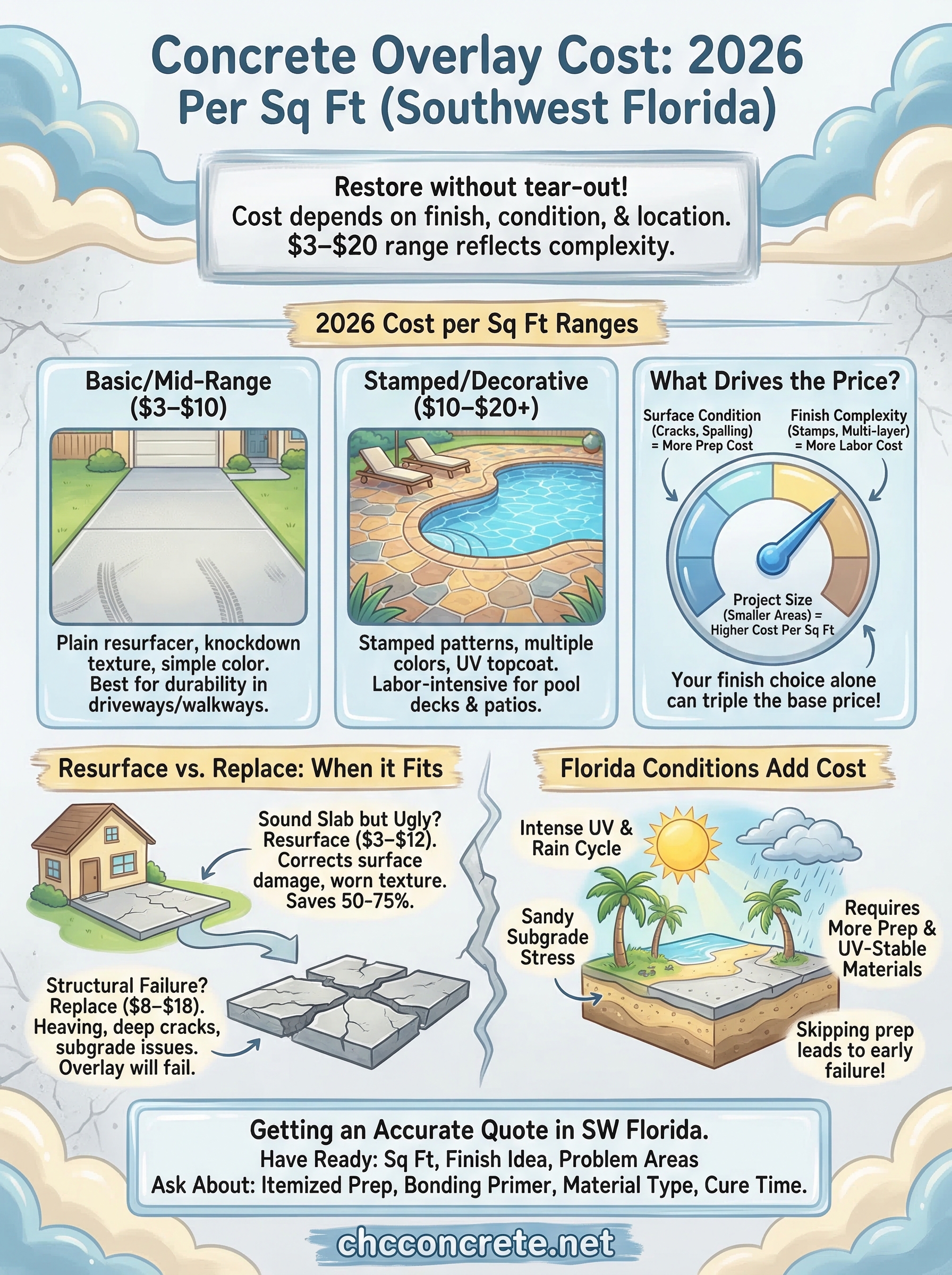
Concrete overlay cost in 2026 runs from about $3 to $20 per square foot installed, depending on finish complexity and surface condition. That wide range reflects the real difference between a plain resurfacer applied over a clean slab and a multi-step stamped system with color and sealer. Most residential projects in Southwest Florida fall somewhere in the middle, with pool decks and patios averaging $6 to $12 per square foot once you factor in prep, material, and finish coats.
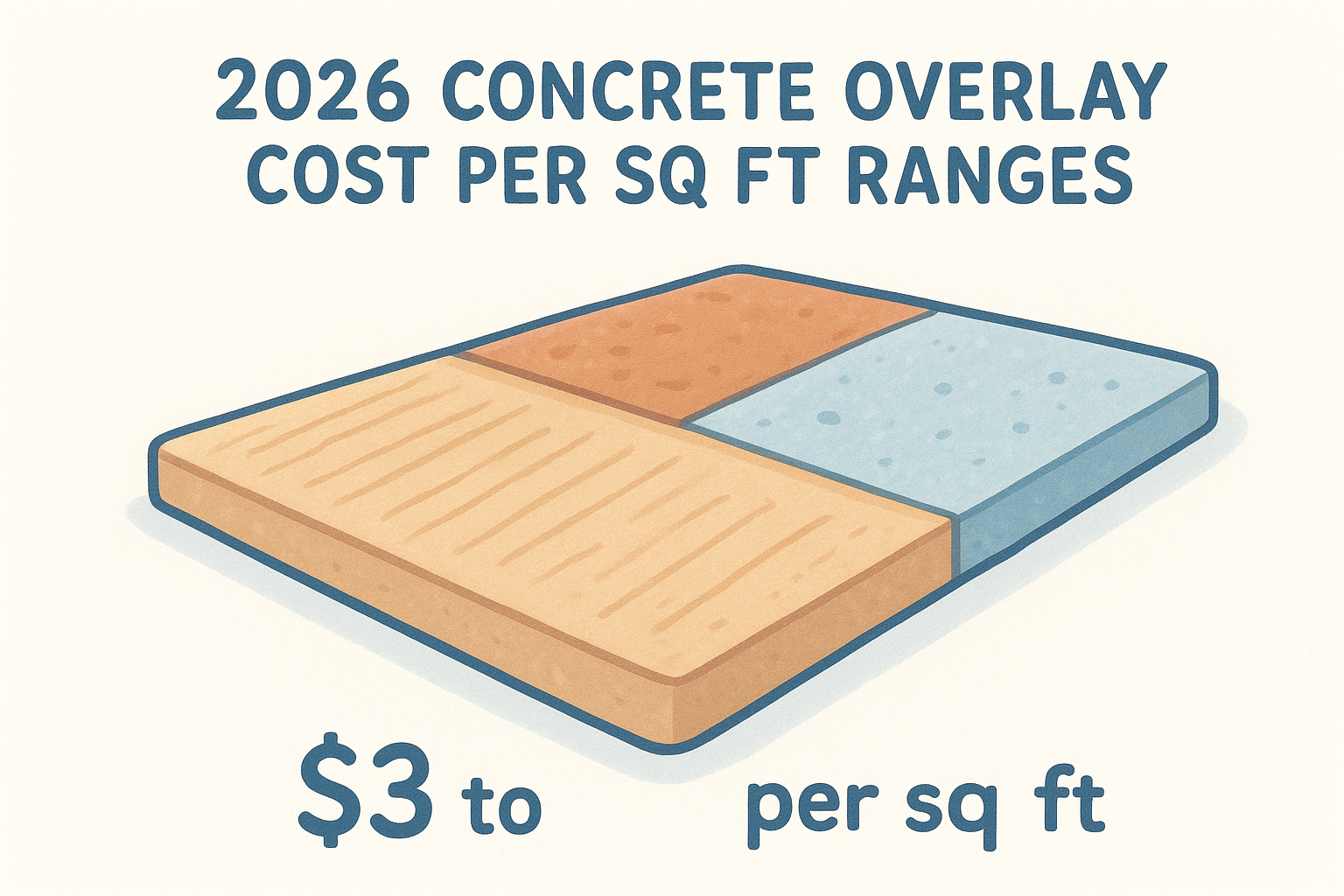
Your finish choice alone can triple the base price, so decide on the look you want before comparing bids.
Basic and mid-range overlays
A basic overlay, typically a thin resurfacer in a broom or knockdown texture, sits at the lower end of the range. These finishes work well for driveways, walkways, and utility areas where durability matters more than appearance. Mid-range options add color and light texture without the complexity of a full stamp pattern.
| Finish Type | Cost Per Sq Ft |
|---|---|
| Plain resurfacer (broom finish) | $3 to $5 |
| Knockdown or skip-trowel texture | $5 to $7 |
| Colored overlay with sealer | $7 to $10 |
These prices assume standard surface preparation on a slab in fair condition. Heavily cracked or spalled concrete adds prep costs before any overlay material goes down.
Stamped and decorative overlays
Stamped and decorative systems are the most labor-intensive overlays available. A contractor applies multiple layers, including a base color coat, stamp pattern, and accent stain, then seals the entire surface with a UV-stable topcoat. This process takes longer and requires skilled labor, which pushes the price toward the higher end of the range.
Decorative overlays for pool decks and entertainment patios in Fort Myers and Cape Coral typically run $10 to $20 per square foot installed. Micro-toppings and custom hand-applied finishes can push past that ceiling depending on the design.
What drives your total concrete overlay price
Several variables push your concrete overlay cost above or below the typical range, and most of them come down to decisions made before the crew ever mixes the first batch. The two biggest cost drivers are the condition of your existing slab and the finish you choose. Everything else, project size, sealer type, and site access, adjusts the final number from there.
Surface condition and prep requirements
Your existing slab sets the baseline for how much prep work the job actually needs. A clean, structurally sound slab with minimal cracking requires less labor before the overlay goes down. A surface with widespread spalling, active cracks, or significant height variation requires grinding, crack repair, and in some cases a leveling coat before the overlay can be applied.
The worse the condition of your existing concrete, the higher your total project cost, regardless of the finish you select.
These prep factors add the most cost to a typical project:
- Active or wide cracks that need flexible filler and stabilization
- Low spots or uneven areas requiring a float coat to level the surface
- Contamination from oil, grease, or efflorescence that requires acid etching or grinding
- Pool decks with peeling or bubbled coatings that must be fully removed first
Project size, thickness, and finish complexity
Larger projects reduce the cost per square foot because setup, material delivery, and mobilization get spread across more area. A 200 square foot patio costs more per square foot than a 1,000 square foot driveway for that reason. Overlay thickness also affects price directly. A standard 3/16-inch resurfacer uses less material than a 3/8-inch build-up coat designed to hide substrate imperfections.
Finish complexity adds labor time on top of material cost. A broom-finish overlay takes far less time than a stamped system that requires multiple color layers, pattern alignment, and detail work on edges and borders. More steps mean more hours, and labor is typically the largest line item on any overlay bid.
Resurface vs replace concrete: cost and fit
The decision between resurfacing and replacing comes down to two things: the structural condition of your existing slab and the total cost difference between both paths. A concrete overlay works when the slab underneath is still sound. Replacement is necessary when the slab has shifted, heaved, or cracked all the way through due to subgrade failure. Choosing the wrong option wastes money regardless of which direction you go.
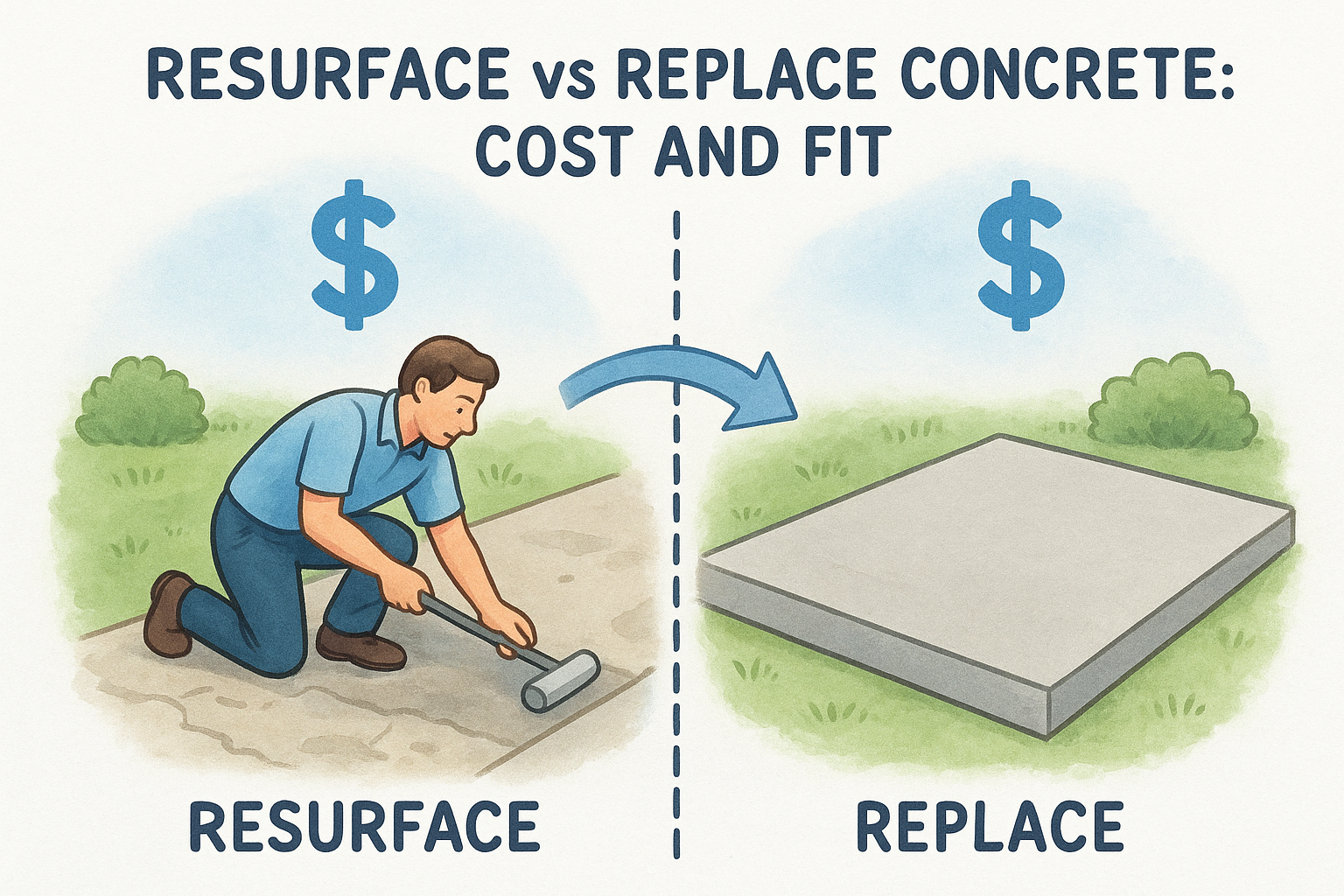
When an overlay fits your project
An overlay is the right call when your concrete is structurally intact but cosmetically damaged. Surface cracks, discoloration, spalling, and worn texture are all problems an overlay corrects without full demolition. In Southwest Florida, pool decks and driveways are the most common candidates because they suffer surface degradation from UV exposure and moisture before the underlying slab gives out.
Resurfacing costs 50 to 75 percent less than full replacement on comparable projects, making it the right first option when the slab is still structurally sound.
The concrete overlay cost for these projects typically runs $3 to $12 per square foot installed, versus $8 to $18 per square foot for a full tear-out and pour on the same surface area.
When replacement makes more sense
Replacement becomes the better option when your slab has structural damage that an overlay cannot fix. If sections have sunk, heaved, or cracked through completely due to subgrade movement, applying an overlay on top only buries the problem. The new surface will crack along the same lines within months, and you’ll end up paying for both the overlay and the replacement in a short timeframe.
Signs that point toward full replacement include multiple full-depth cracks, sections that rock or flex when walked on, and significant differential settlement between slab sections. In Southwest Florida, sandy soil under slabs can wash out during heavy rain events, which causes this type of subgrade failure more often than in other regions.
How to get an accurate overlay quote in SW Florida
Getting an accurate concrete overlay cost estimate in Southwest Florida starts with knowing what to ask and what to provide. Contractors who give you a firm number without seeing the slab in person are guessing, and those guesses usually shift once work begins. An on-site visit lets the contractor assess surface condition, drainage patterns, and access, all of which affect the final price.
What to have ready before the appointment
Walking into a quote conversation with clear information saves time and gets you a more accurate number. Know the square footage of the area you want to resurface and have a general idea of the finish you prefer. If you’ve noticed specific problem areas like cracks or low spots, point those out directly during the inspection.
Bring these details to your quote appointment:
- Approximate square footage
- Current condition of the slab (cracks, spalling, previous coatings)
- Intended use of the surface (pool deck, driveway, patio)
- Any timeline or access constraints
Questions to ask every contractor
Not every contractor follows the same process, so asking direct questions separates thorough work from shortcuts. Ask specifically what surface preparation is included in the bid and whether bonding primer, crack repair, and sealer are all itemized separately. A bid that lumps everything into one number makes it impossible to compare quotes fairly.
A contractor who explains every line item in their bid understands the work, and that transparency protects you once the project starts.
Also ask about the overlay product brand and thickness, warranty terms, and how long the surface needs to cure before use. In Southwest Florida’s heat and humidity, cure time matters more than in cooler climates, and a contractor who addresses this upfront demonstrates the kind of local knowledge that produces a durable finished surface rather than one that fails within the first rainy season.
Conclusion
Concrete overlay cost runs from $3 to $20 per square foot in 2026, and where your project lands in that range depends on your slab’s condition, the finish you choose, and how thoroughly a contractor prepares the surface before any material goes down. A plain resurfacer over a clean driveway costs far less than a stamped, multi-layer pool deck system, but both options deliver real value when the work is done right.
Southwest Florida’s heat, UV intensity, and sandy subgrade make surface prep and material selection more important here than in most other markets. Skipping steps to lower the upfront price almost always costs more within a few years. If your slab is structurally sound and you want a durable, good-looking surface without full replacement, an overlay is worth a serious look. Get a free estimate from CHC Concrete and find out exactly what your project requires.