


A cracked, sunken, or crumbling driveway does more than hurt your curb appeal, it can become a safety hazard and drag down your property value. If you’ve reached the point where patching won’t cut it anymore, understanding the full concrete driveway replacement cost is the first step toward making a smart investment. National averages give you a starting point, but the real number depends on factors specific to your property, your region, and the scope of work involved.
Here in Southwest Florida, those factors hit differently. Sandy soil, heavy rain cycles, and relentless UV exposure all affect how a driveway should be built, and what it costs to do it right. At CHC Concrete, we handle driveway replacements across Fort Myers, Cape Coral, Estero, and Bonita Springs, so we see these numbers play out on real job sites every week. That hands-on experience is exactly what shaped this guide. We built it to give you an honest look at 2026 pricing, from demolition and base prep to finishing and curing, so you can budget with confidence or pressure-test a quote you’ve already received.
Below, you’ll find per-square-foot pricing, a breakdown of what drives costs up or down, and practical advice to help you get the most value out of your replacement project.
Why concrete driveway replacement costs vary
No two driveways are exactly alike, and that’s why concrete driveway replacement cost quotes can range so widely from one property to the next. Several distinct variables stack on top of each other to produce your final number. Understanding each one helps you figure out whether a quote is reasonable or whether something is being left out entirely.
Driveway size and layout
The most obvious cost driver is total square footage. A standard two-car driveway runs roughly 400 to 600 square feet, but longer driveways, wide aprons, or curved approaches can push that number considerably higher. Every additional square foot adds material, labor, and time, so even a modest size increase carries a real price impact.
Shape matters too. A straight rectangular pour is the most straightforward project a crew can run. Curves, angles, and layouts that wrap around a structure require more precise forming work, which adds labor hours even when the total square footage stays the same.
Demolition and debris removal
Before any new concrete goes in, the old slab has to come out. Demolition and hauling are often quoted as a separate line item, and they can add $1 to $2 per square foot depending on slab thickness and how accessible the site is. A thicker old slab takes longer to break up and generates more debris to remove.
Pouring new concrete over a failed slab instead of removing it is one of the most common shortcuts that leads to early cracking and sinking.
If your current driveway sits close to a structure, a pool deck, or established landscaping, the crew has more constraints to work around. Those access limitations drive up the time and cost of removal, even on a smaller driveway.
Soil conditions and base preparation
This factor carries more weight in Southwest Florida than in most other parts of the country. Sandy soil shifts, settles, and drains differently than clay or compacted fill, which means base preparation has to be done correctly or the new slab will fail ahead of schedule. A properly graded and compacted base with the right aggregate depth takes more time and material than a basic scrape-and-pour approach.
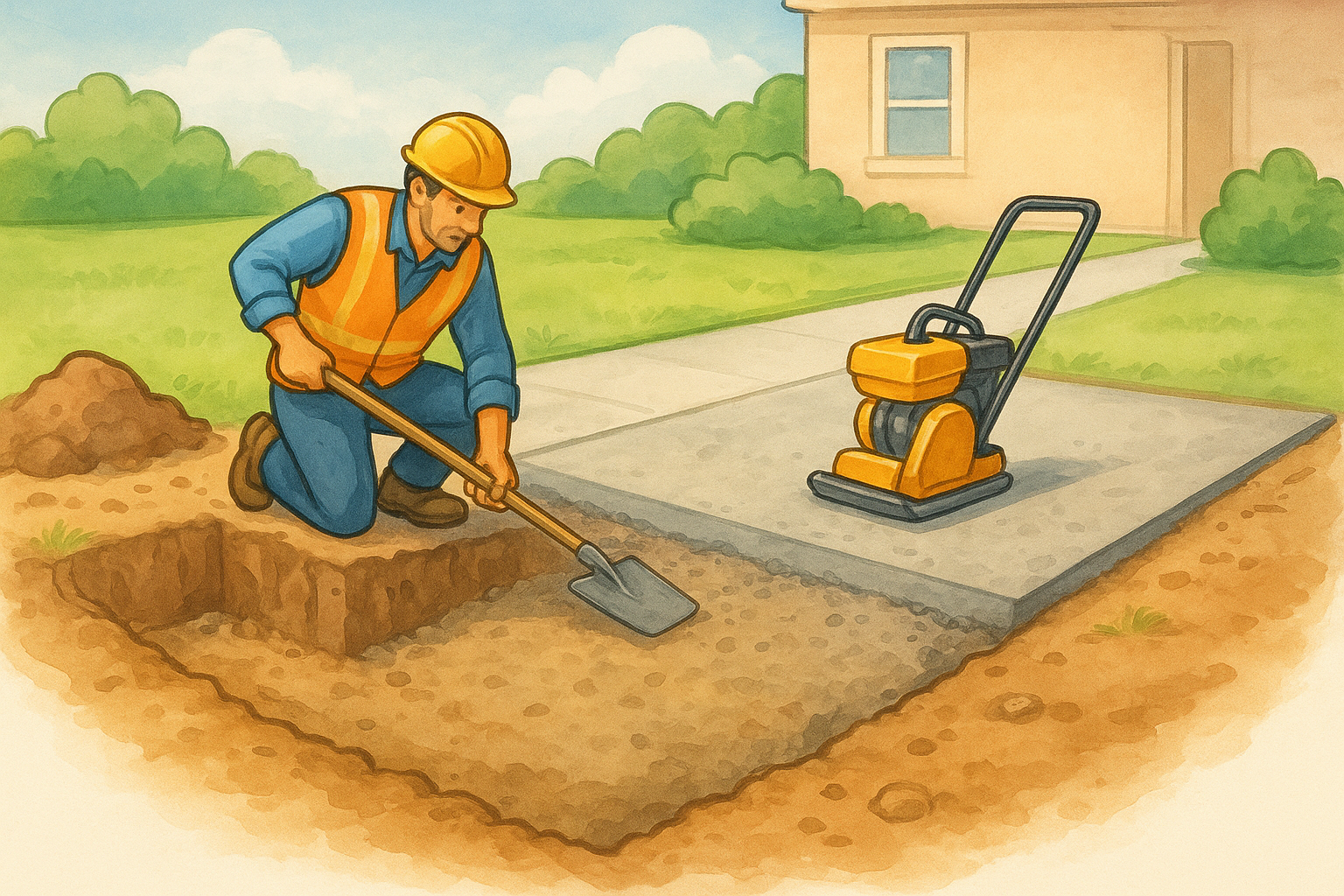
Your site may also need grading adjustments or slope corrections to direct stormwater away from the slab. Heavy rainfall cycles here make drainage a structural consideration, not just an aesthetic one. These added steps increase upfront cost but protect your investment over the long run.
Concrete mix specs and finish type
The mix itself directly affects your material cost. A standard residential driveway in Florida typically calls for a 4,000 PSI mix at 4 inches thick. Moving to 5 or 6 inches, or specifying a higher-strength mix to handle heavy vehicle traffic, raises both material volume and pour time. Reinforcement choices, whether rebar or wire mesh, also affect price and are non-negotiable for a slab that needs to hold up against ground movement.
Finish type is another significant variable. A basic broom finish is the most affordable option and performs well in residential applications. Decorative choices such as stamped patterns, exposed aggregate, or integral color can add $4 to $8 per square foot on top of the base cost, depending on pattern complexity and the number of color layers involved.
How much concrete driveway replacement costs in 2026
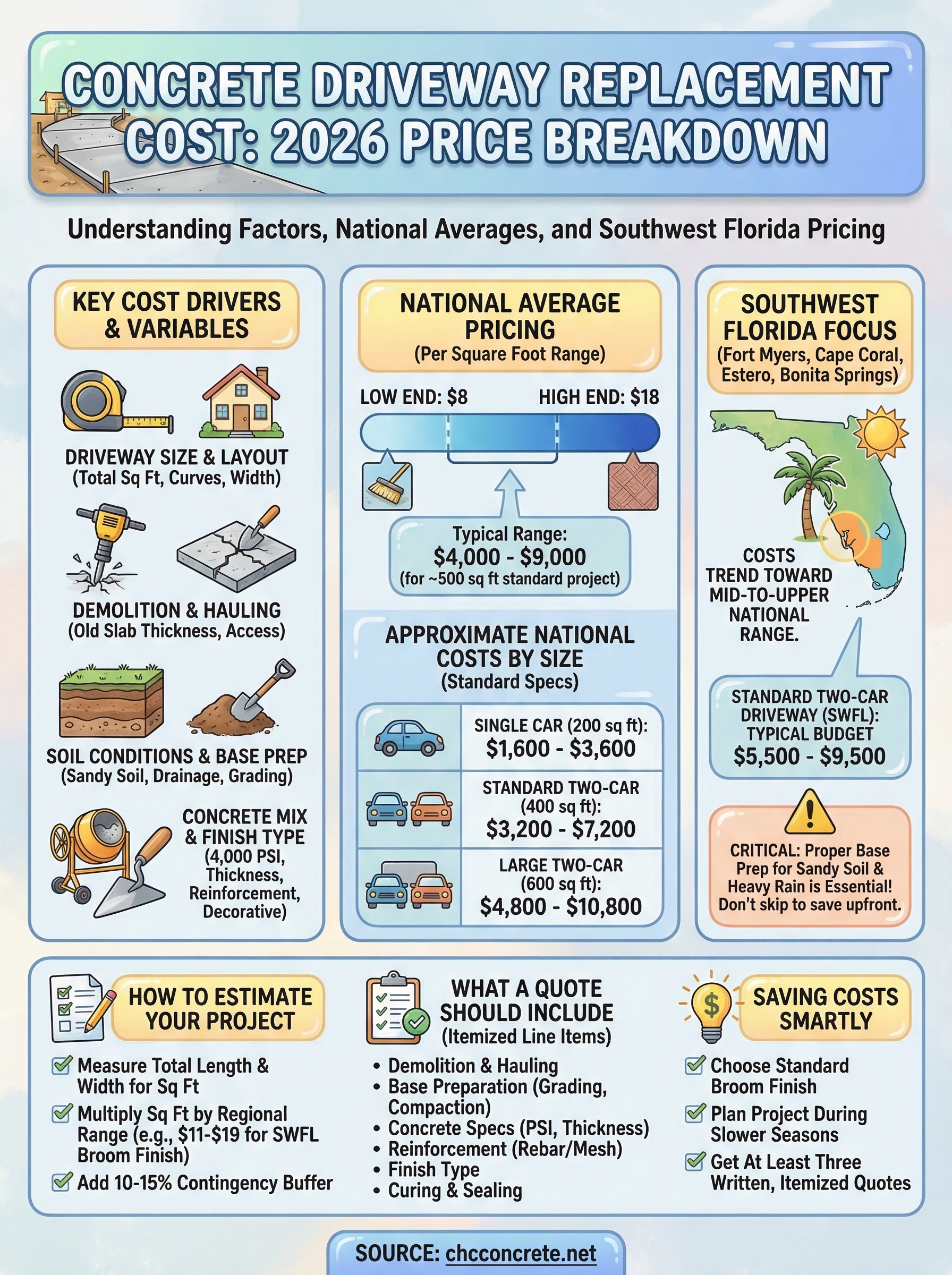
Getting a realistic handle on concrete driveway replacement cost starts with knowing where national benchmarks sit, then adjusting for your specific location and conditions. Nationally, homeowners pay between $8 and $18 per square foot for a full replacement, including demolition, base prep, and a standard broom-finish pour. On a 500-square-foot driveway, that puts the total project range at roughly $4,000 to $9,000 before any upgrades or site complications.
National average pricing by driveway size
The per-square-foot range breaks down into distinct cost layers. Labor typically accounts for 40 to 50 percent of the total, with materials making up most of the remainder. The table below shows approximate cost ranges for common driveway sizes at standard specs.
| Driveway Size | Low Estimate | High Estimate |
|---|---|---|
| 200 sq ft (single car) | $1,600 | $3,600 |
| 400 sq ft (standard two-car) | $3,200 | $7,200 |
| 600 sq ft (large two-car) | $4,800 | $10,800 |
| 800 sq ft (extended or three-car) | $6,400 | $14,400 |
These figures assume a 4-inch slab with standard reinforcement and a basic broom finish. Decorative finishes, thicker pours, or complex site conditions will push your number toward the higher end or beyond it. Use these ranges as a starting framework, not a final budget.
What Southwest Florida projects typically run
Projects in Fort Myers, Cape Coral, Estero, and Bonita Springs tend to land toward the mid-to-upper end of national ranges, primarily because of the soil and drainage preparation required. Sandy soil and frequent heavy rainfall cycles mean base work here is more involved than in drier climates with firmer ground, and that added preparation shows up in your quote.
Skipping proper base preparation to reduce upfront cost is one of the fastest ways to end up with a cracked, sinking slab within three to five years.
For a standard two-car driveway in Southwest Florida, most homeowners should budget between $5,500 and $9,500 once you factor in demolition, proper base compaction, reinforcement, and a quality pour. That range shifts upward if your driveway runs longer than average, requires slope corrections for drainage, or includes a decorative finish such as stamped concrete or exposed aggregate.
How to estimate your driveway replacement cost
You don’t need a contractor on-site to get a rough sense of what your project will cost. A few simple measurements and some basic math can get you to a working budget estimate before you ever pick up the phone. That gives you a realistic target and a baseline to pressure-test contractor quotes once they start arriving.
Measure your driveway accurately
Start by measuring the total length and width of your existing driveway in feet, then multiply those two numbers to get your square footage. If your driveway isn’t a simple rectangle, break it into sections, calculate each one separately, and add them together. This number is the foundation of your entire estimate.
From there, multiply your square footage by the per-square-foot range that matches your finish type and location. For a standard broom-finish replacement in Southwest Florida, use $11 to $19 per square foot as your working range. That spread accounts for demolition, base prep, and the soil conditions typical in this region.
Account for the variables that shift your number
Your square footage gives you a starting point, but several factors will push your concrete driveway replacement cost toward the high end of that range or beyond it. Run through this checklist before you lock in a final budget number:
- Slab thickness: A 5- or 6-inch pour for heavy vehicles adds material and labor cost over a standard 4-inch slab.
- Decorative finish: Stamped concrete or exposed aggregate adds $4 to $8 per square foot on top of the base estimate.
- Drainage or grading corrections: If your yard drains toward the driveway, slope adjustments add to your base prep costs.
- Demolition complexity: Thick old slabs or tight site access increase the removal portion of your quote.
- Reinforcement type: Rebar costs more than wire mesh but provides stronger resistance against ground movement.
Adding a 10 to 15 percent contingency buffer on top of your estimate gives you room for unexpected site conditions without blowing your budget.
After working through these variables, you’ll have a number solid enough to evaluate bids with real confidence.
What a replacement quote should include
A written quote tells you far more than just a final number. When you receive a bid for your concrete driveway replacement, every cost component should be listed separately so you can see exactly what you’re paying for. A vague single-line quote with one price and no detail is a sign that the contractor either hasn’t fully scoped the job or is leaving room to add charges later.
A quote that breaks down each phase of the work protects you from hidden costs and gives you a clear basis for comparing multiple bids side by side.
Line items that should be spelled out
Every legitimate quote for a concrete driveway replacement cost should show each phase of the project as a distinct line item. When you read through a bid, look for these components listed separately:
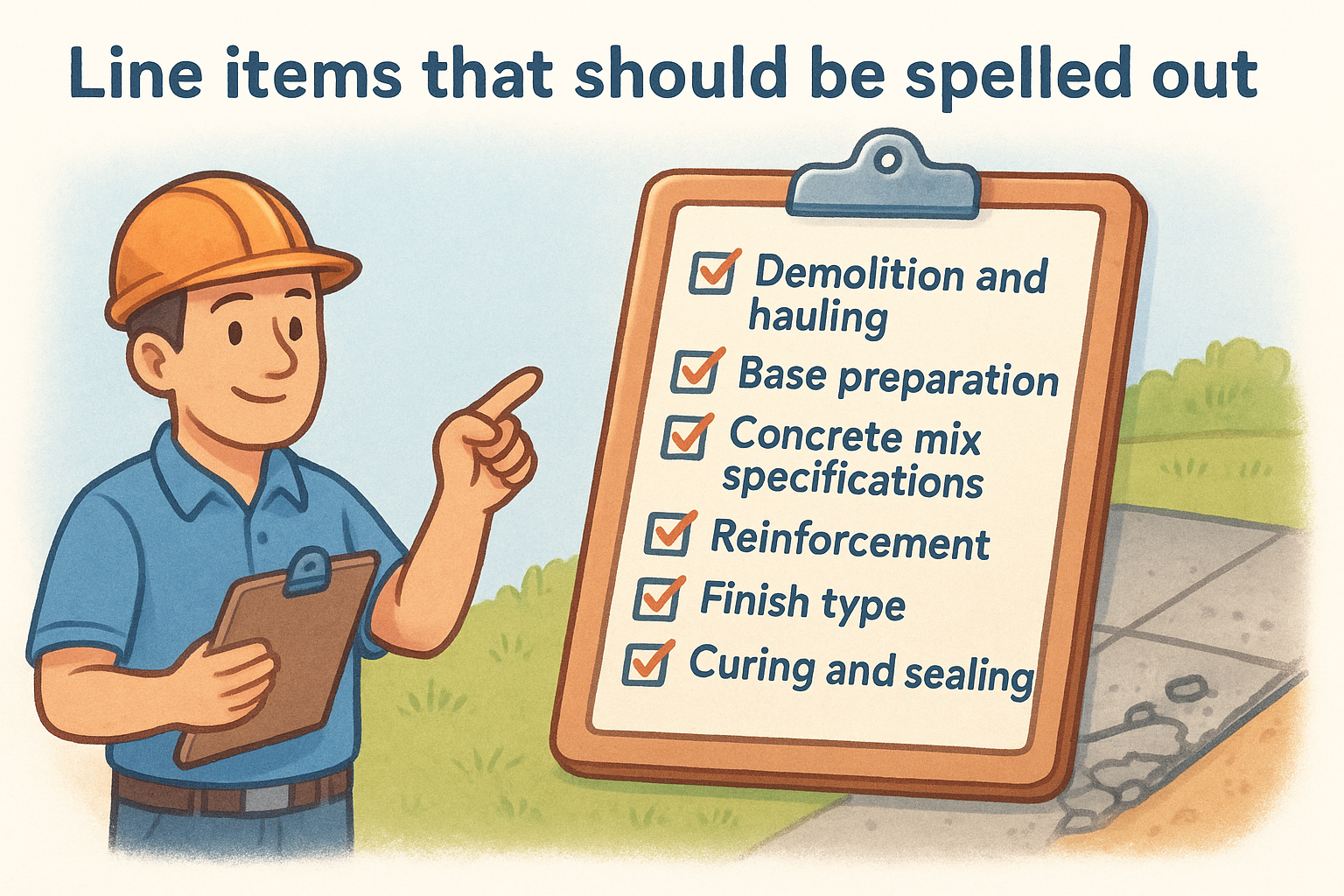
- Demolition and hauling: The cost to break up and remove your existing slab, listed per square foot or as a flat fee
- Base preparation: Grading, compaction, and aggregate work required before the pour
- Concrete mix specifications: The PSI rating, slab thickness, and total cubic yardage being ordered
- Reinforcement: Whether the quote includes rebar or wire mesh, and at what spacing
- Finish type: The specific finish being applied, whether broom, stamped, or exposed aggregate
- Curing and sealing: Whether a curing compound or sealer is included after the pour
If any of these items are missing, ask the contractor to add them before you sign anything.
Red flags in a quote
Some warning signs in a quote deserve serious attention before you commit. A bid that skips the demolition line item entirely could mean the contractor plans to pour over your existing slab rather than replace it, which leads to early failure. A quote that doesn’t specify concrete PSI or slab thickness leaves the contractor free to use a lower-grade mix without violating the agreement.
Watch for bids that are significantly lower than others you’ve received. That gap usually points to a thinner slab, missing reinforcement, or inadequate base prep rather than a better deal. Protecting your investment starts with knowing what’s actually in the contract before the first saw cuts your old slab.
Ways to keep costs down without cutting corners
Reducing your concrete driveway replacement cost doesn’t require sacrificing quality. It requires making smarter choices about timing, finish type, and how you approach the bidding process. The goal is to find real savings without compromising the base preparation, reinforcement, or mix specs that determine how long your driveway actually lasts.
Choose a standard finish
Decorative finishes like stamped concrete or exposed aggregate add $4 to $8 per square foot on top of your base price. If your primary goal is a functional, long-lasting slab, a broom finish delivers the same structural performance at a lower cost. A well-executed broom finish also provides natural slip resistance, which matters on a Florida driveway exposed to afternoon rain.
Skipping the decorative upgrade is one of the few areas where spending less has zero impact on how your driveway performs over time.
Plan your project during the slower season
Concrete contractors in Southwest Florida tend to stay busiest during the late fall and early spring months when weather is mild and homeowner demand peaks. Scheduling your project during the summer or early fall, when contractors have more availability, often translates to better pricing and faster turnaround. Contractors are more likely to sharpen their bids when their schedule has open slots to fill.
Get at least three written quotes
Comparing multiple bids is one of the most effective ways to make sure you’re paying a fair price. When you receive each quote, verify that every bid covers the same scope of work, including demolition, base prep, concrete specs, and reinforcement. A lower bid that omits any of those phases isn’t actually cheaper. You’re just paying for a portion of the work rather than the full job.
Requesting that contractors itemize each phase separately also makes it easy to spot where bids differ. If one contractor prices base preparation significantly lower than others, that’s worth asking about directly. Understanding what sits behind each number helps you choose the bid that delivers the most complete project at a competitive price.
Next steps for your driveway project
You now have the pricing framework, the variables that drive your concrete driveway replacement cost, and the knowledge to evaluate any quote that lands in your inbox. The next move is straightforward: measure your driveway, build your working budget, and start collecting written bids from licensed, insured contractors who break down every phase of the work in detail.
For homeowners in Fort Myers, Cape Coral, Estero, and Bonita Springs, local soil conditions and drainage requirements make contractor selection especially important. A crew that understands Southwest Florida’s sandy substrate and heavy rainfall cycles will build your base correctly the first time, which is what separates a slab that lasts decades from one that needs attention in three years. If you’re ready to move forward, request a free estimate from CHC Concrete and get a detailed, itemized quote built around your specific property.