


If you’re planning a new driveway, patio, or pool deck in Southwest Florida, chances are you’ve landed on the same fork in the road most homeowners hit: stamped concrete vs pavers. Both options look great. Both hold up well. And both come with trade-offs that aren’t always obvious until the project is already underway.
The right choice depends on more than just appearance. Budget, long-term maintenance, local soil conditions, and how the surface handles Florida’s heat and rain all play a role. A material that works perfectly in a mild climate can behave very differently when it sits on sandy soil under relentless UV exposure and tropical downpours. That’s something we deal with on every project at CHC Concrete, where we install both stamped concrete and pavers across Fort Myers, Cape Coral, Estero, and Bonita Springs.
This guide breaks down the real differences between the two, cost, durability, maintenance, and installation, so you can make a decision based on facts, not guesswork. We’ll cover where each option excels, where it falls short, and which scenarios favor one over the other.
Why this choice matters in Southwest Florida
Southwest Florida isn’t a forgiving environment for outdoor surfaces. Sandy, shifting soil beneath your driveway or patio creates conditions that stress concrete slabs and paver bases in very different ways, and what holds up in a northern state can fail here within just a few years. Picking the wrong surface isn’t only an aesthetic mistake; it can lead to cracking, lifting, and costly repairs that eat into your budget well before you expected them.
Sandy soil and drainage
The ground in Fort Myers, Cape Coral, and surrounding areas is largely sandy and poorly compacted by nature, which means surface water doesn’t always drain away from your property the way it would on denser soil. During heavy summer rainstorms, that water has to go somewhere, and if your surface or its base isn’t designed to handle the volume, you’ll see pooling, erosion, and gradual shifting that worsens with every storm season.
The base preparation under your surface matters as much as the surface material itself in Southwest Florida conditions.
Your contractor’s approach to grading, compaction, and sub-base thickness directly determines how well either option holds up long-term, regardless of which material you choose.
Heat, UV, and humidity
Florida’s sun is relentless from May through September, and surface temperatures on unshaded concrete or pavers can push well past 100°F on a typical afternoon. Materials that absorb and retain heat can make a pool deck or patio nearly unusable during peak hours. Beyond heat, high humidity and repeated moisture cycles accelerate the breakdown of sealers, joint sand, and surface finishes far faster than in drier climates.
Both materials respond to these stresses differently, which makes local climate a central factor in any stamped concrete vs pavers decision. Understanding how each one holds up under Florida-specific conditions is where a meaningful comparison actually starts.
Stamped concrete vs pavers: key differences
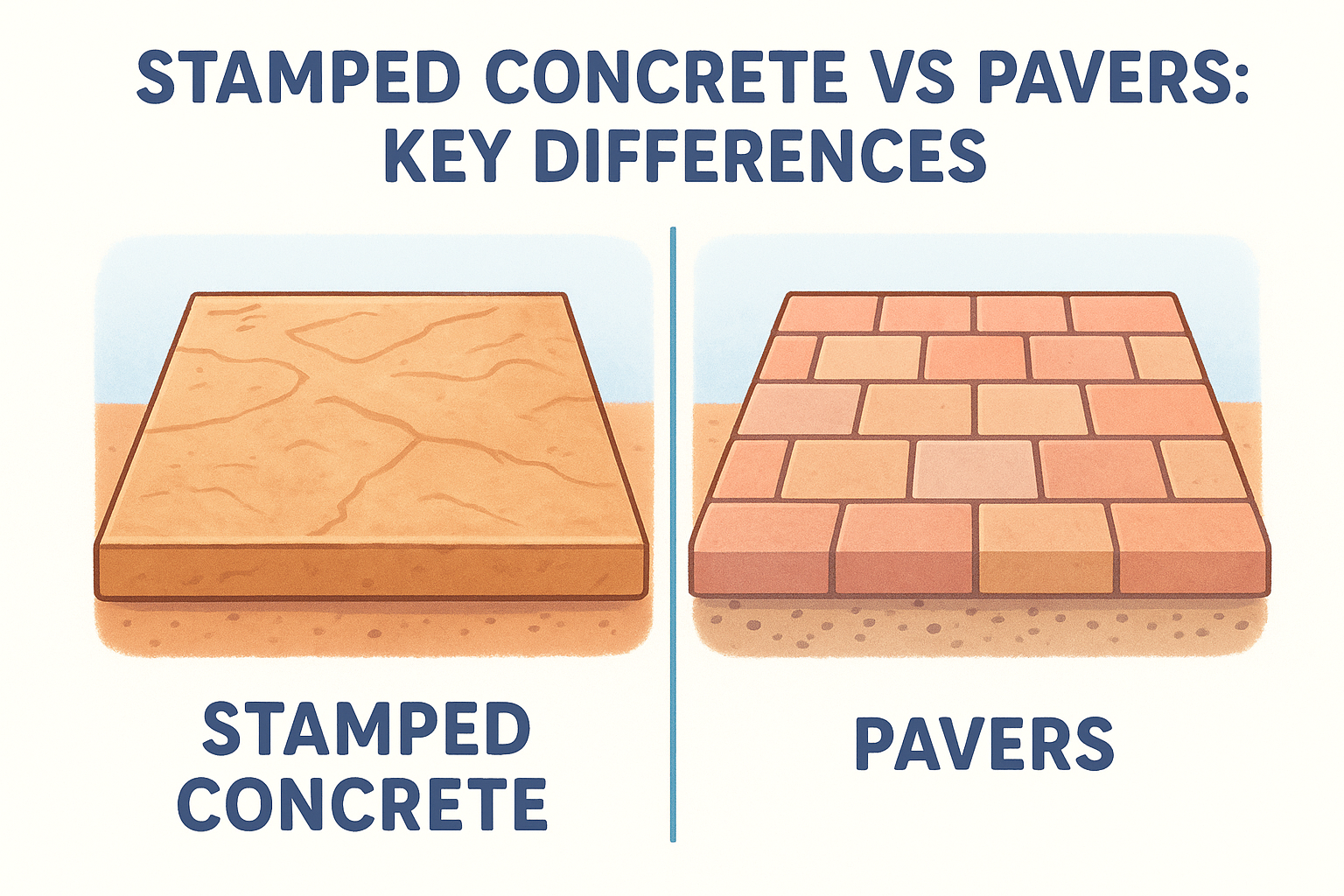
When you weigh stamped concrete vs pavers, the most fundamental distinction is how each material is built. Stamped concrete is poured as a single continuous slab, imprinted with texture molds, and colored before it cures. Pavers are individual precast units, either concrete or natural stone, set into a compacted sand and gravel base and held in place with joint sand.
Structure and movement
Stamped concrete creates a monolithic surface that moves as one piece under stress. In Florida, sandy soil shifts and heat cycles apply pressure across the entire slab at once. Pavers form a flexible, modular system where each unit can adjust slightly without fracturing the entire surface.
A stamped slab that isn’t properly reinforced and control-jointed will almost certainly crack under Florida’s combination of sandy soil and thermal expansion.
Repair and flexibility
Fixing a cracked or discolored section of stamped concrete is difficult because matching the original color and texture exactly is rarely possible. Pavers let you remove and replace individual units without disturbing the rest of the surface.
| Feature | Stamped Concrete | Pavers |
|---|---|---|
| Surface type | Monolithic slab | Individual units |
| Crack resistance | Lower | Higher |
| Repair ease | Difficult | Simple |
Cost: upfront pricing and long-term value
Cost is usually the first number homeowners want pinned down, but upfront price and total cost over time aren’t always the same figure. In the stamped concrete vs pavers debate, both materials land in a similar range per square foot installed, but how each one ages in Florida changes the long-term math significantly.
Upfront installation costs
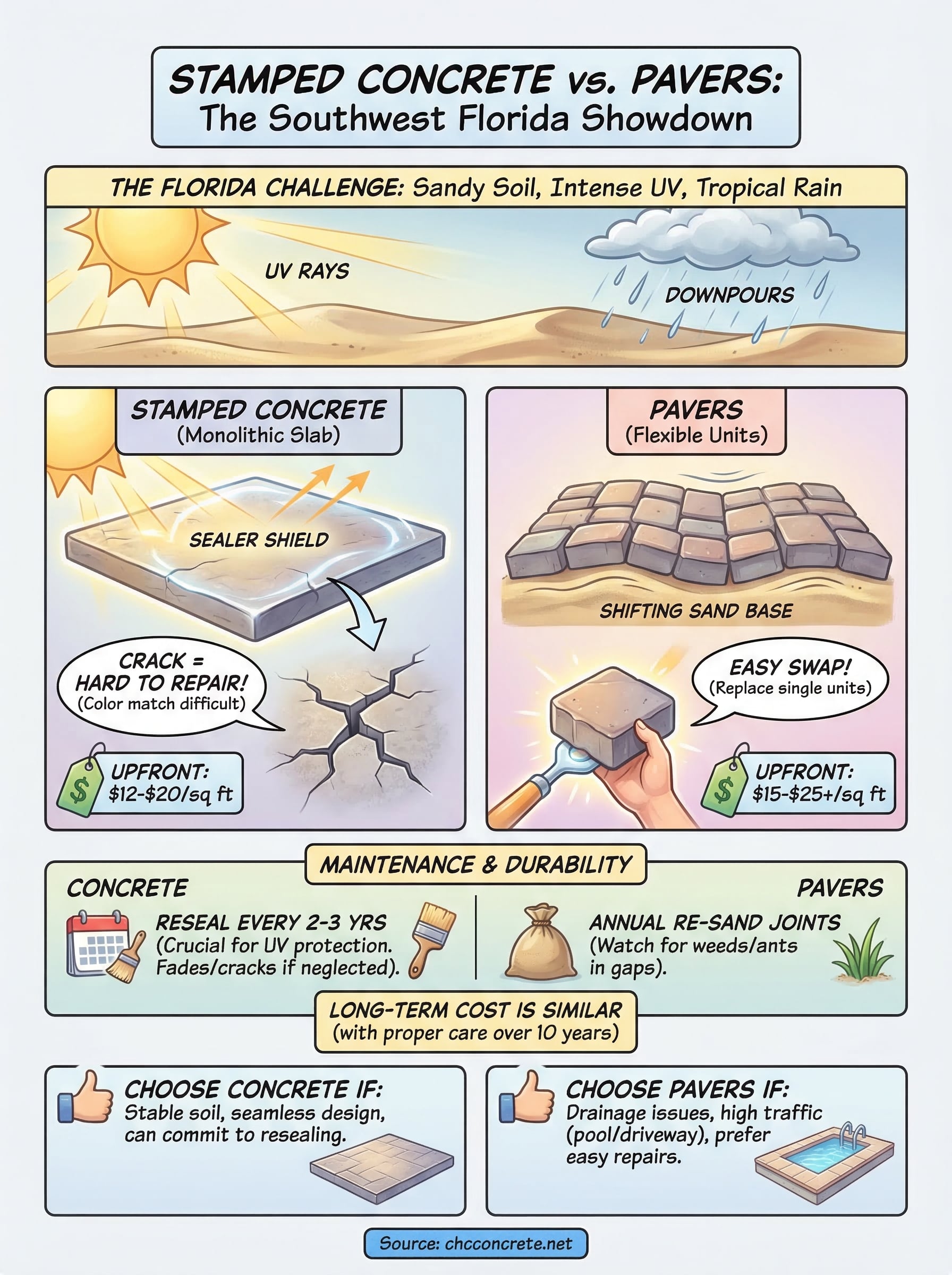
Stamped concrete typically runs $12 to $20 per square foot installed, depending on pattern complexity and color choices. Pavers generally cost $15 to $25 per square foot, with natural stone pushing higher. Labor accounts for a significant portion of both, since proper base preparation in sandy Florida soil adds time regardless of the material.
Your total project cost often has more to do with base preparation and site grading than the surface material itself.
Long-term value and repair costs
Your biggest ongoing cost with stamped concrete is sealer maintenance every two to three years and the difficulty of repairing visible cracks without a matching color. Pavers carry lower per-repair costs since you replace individual units rather than patch a slab, though re-sanding joints and managing weed intrusion adds periodic upkeep expenses. Over a 10-year window, both options often reach similar totals when you maintain them properly.
Durability and maintenance in Florida conditions
In stamped concrete vs pavers, durability isn’t just about material strength; it’s about how each surface handles Florida’s specific stress cycle of intense heat, heavy rain, and sandy soil movement over time.
Stamped concrete wear
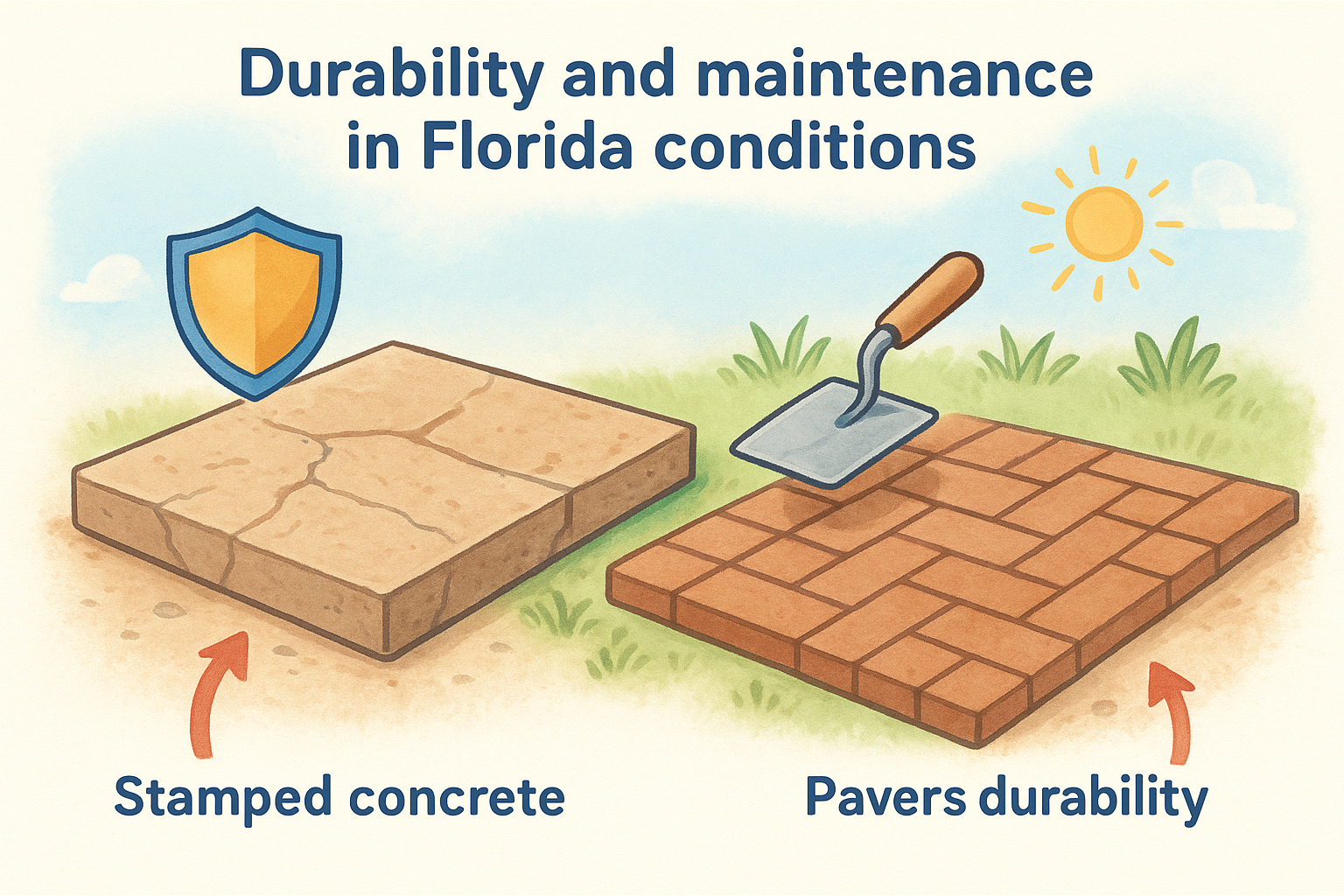
Stamped concrete holds up well when properly sealed and reinforced, but the sealer is its weak point in Florida’s climate. UV exposure breaks down the coating faster than in cooler regions, and once the sealer degrades, surface color fades and moisture penetrates the slab. You should plan to reseal every two to three years to maintain both appearance and protection.
Skipping a resealing cycle in Florida doesn’t just cost you curb appeal; it accelerates surface erosion and deepens any existing cracks.
Paver durability and upkeep
Pavers handle Florida’s stress conditions better structurally because individual units flex slightly with soil movement rather than fracturing as a single slab would. Your main maintenance tasks are re-sanding joints annually and watching for weed growth or ant activity in the gaps, both of which are manageable with routine attention. Surface wear is minimal since pavers don’t rely on a sealer coat for structural protection, which reduces the number of maintenance cycles you’ll need over the life of the surface.
How to choose the right surface for your project
The stamped concrete vs pavers decision comes down to three factors: budget, maintenance tolerance, and how the surface will actually be used. Neither option is universally better, but most projects lean clearly toward one once you honestly assess your site conditions and priorities with your contractor.
Your soil quality and drainage situation should carry as much weight in this decision as aesthetics or upfront price.
When stamped concrete makes sense
Stamped concrete works best when you want a seamless, unified look across a large area and you’re prepared to reseal every two to three years. It’s also the right fit if lower upfront cost matters and you’re comfortable managing maintenance to protect the surface over time.
- You want a large, continuous design pattern
- Your site has stable compaction and adequate drainage
- You can commit to a routine resealing schedule
When pavers are the better fit
Pavers work better when low long-term maintenance is your priority or your property has drainage challenges that need a flexible base. Choose pavers for pool decks, driveways, and high-traffic areas where replacing individual units is far simpler than patching a cracked slab.
Florida’s sandy soil shifts enough over time that pavers’ modular structure consistently reduces visible surface damage. This matters especially on driveways and entries where heavy loads and intense sun exposure combine to stress a continuous slab more aggressively than individual units.
Next steps for your patio or driveway
Now that you’ve worked through the stamped concrete vs pavers comparison, the next move is straightforward: match what you’ve learned to your specific project conditions. Think about your site’s drainage, your maintenance commitment, and your budget over a 10-year window, not just the upfront install price. Those three factors will point you clearly toward one option.
From there, get an on-site assessment from a contractor who knows Southwest Florida’s soil and climate conditions firsthand. A proper site visit lets your contractor evaluate base preparation requirements, drainage grading, and surface options that fit your property rather than generic recommendations. That’s exactly how we approach every project at CHC Concrete.
If you’re ready to move forward on a driveway, patio, or pool deck in Fort Myers, Cape Coral, Estero, or Bonita Springs, request a free estimate from CHC Concrete and get a clear plan built around your property.