


A cracked or sinking driveway doesn’t fix itself, and the longer you wait, the worse (and more expensive) the problem gets. If you’re searching for concrete driveway repair cost estimates, you’re probably staring at damage right now and trying to figure out what you’re actually looking at budget-wise. The answer depends on several factors, the type of damage, the square footage involved, and whether you hire a professional or attempt it yourself.
In 2026, homeowners across the country are paying anywhere from a few hundred dollars for minor crack filling to several thousand for full-section replacement. Here in Southwest Florida, costs can shift further based on local soil conditions, sun exposure, and drainage demands that don’t exist in most other parts of the country. Sandy substrate, heavy rain cycles, and relentless UV all take a specific toll on concrete, and the repair approach needs to account for that, or you’ll be paying twice.
At CHC Concrete, we handle driveway repairs throughout Fort Myers, Cape Coral, Estero, and Bonita Springs, so we see firsthand what these projects actually cost in our area. This guide breaks down national and regional pricing per square foot, compares DIY versus professional costs, and walks you through the variables that move your final number up or down. The goal is simple: give you real numbers so you can make a confident decision before a single dollar is spent.
Why driveway repair costs vary so much
No two driveway repair projects come in at the same price, and that’s not a contractor making things up as they go. Several interconnected variables determine what your final bill looks like, and understanding them upfront keeps you from getting surprised when quotes arrive higher or lower than you expected. The concrete driveway repair cost can swing dramatically based on what’s actually wrong, how much surface area is affected, and where the work is being done.
The type and extent of damage
The single biggest cost driver is what kind of damage you have and how deep it goes. A hairline crack running across the surface is a completely different job than a sunken section that has cracked, shifted, and started to separate from the base. Surface-level cracks can often be addressed with crack filler and sealant, which keeps material costs low and labor time short. The moment damage extends below the surface slab to the base layer or the substrate beneath it, you’re looking at removal, re-grading, and replacement, which multiplies the cost significantly.
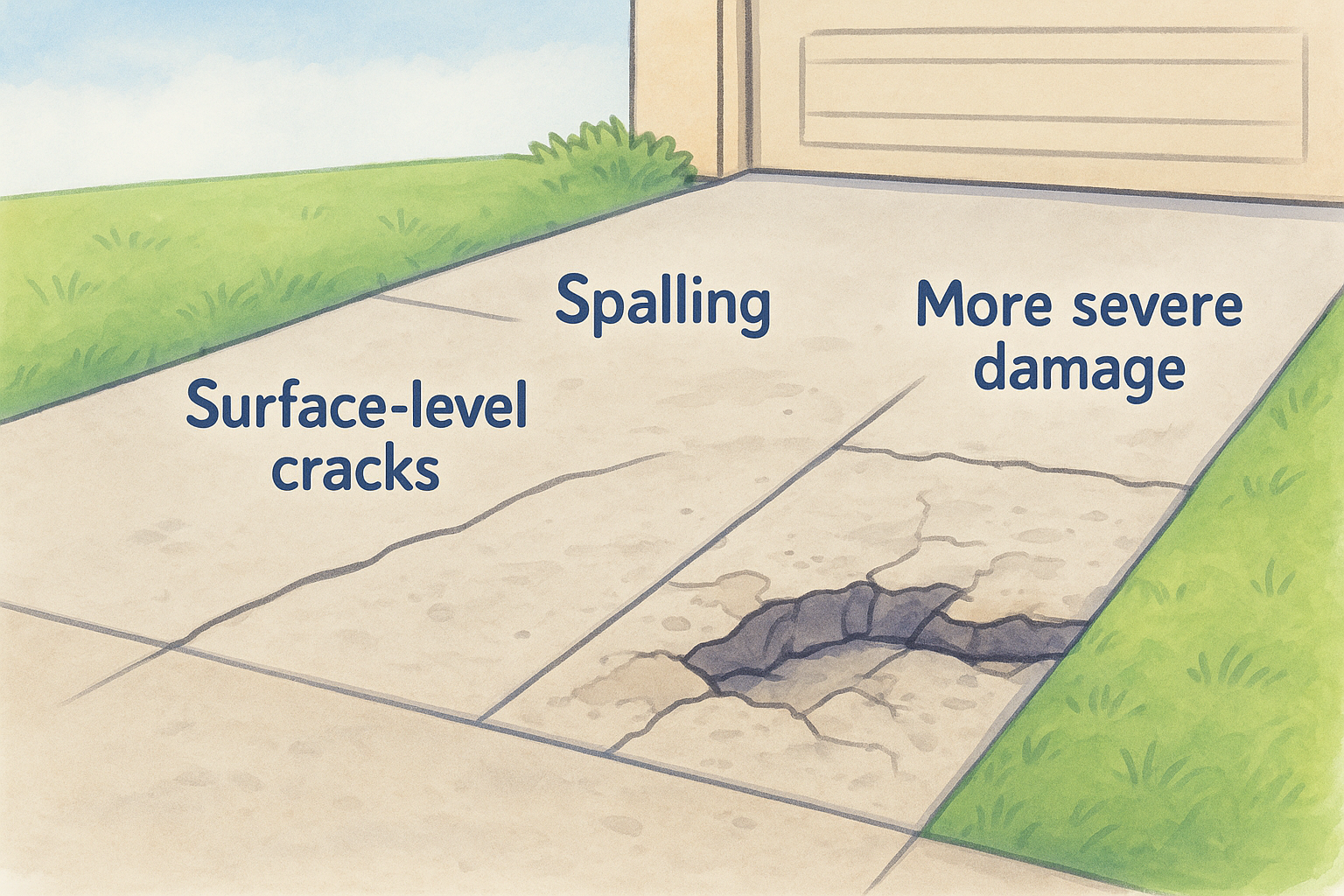
Spalling sits somewhere in the middle. That’s when the concrete surface flakes and deteriorates from the top down, often from freeze-thaw cycles or UV breakdown. Widespread spalling across a large section may require resurfacing the entire area rather than patching, which means more material and more preparation time. The pattern is consistent: the deeper the damage goes, the higher the cost climbs.
Surface cracks caught early can cost a fraction of what you’d pay once water infiltrates the slab and begins eroding the base beneath it.
Surface area and accessibility
Square footage is the most straightforward cost multiplier in any concrete repair project. A 10-square-foot patch near a garage apron costs far less than a 200-square-foot section of a long driveway that has cracked across multiple slabs. Contractors price most repair work per square foot, so the larger the affected area, the higher your total, even when the per-foot rate stays flat.
Accessibility also plays a role that homeowners often overlook. If the damaged section sits close to your garage, near utility lines, or along a narrow side yard, equipment access becomes limited, which drives up labor time. Tight spaces require smaller tools, more manual work, or longer setup periods, and all of that adds to your final number.
Materials, labor, and local market conditions
Concrete mix, reinforcement materials, and finishing products all carry their own price tags, and those prices shift with supply chains and regional demand. During busy construction seasons or in high-demand markets, both material and labor costs tend to rise. Labor rates vary considerably from one region to the next, and a contractor in a high-cost metro will quote differently than one working in a rural area for identical scope.
Your geographic location shapes more than just labor pricing. In Southwest Florida specifically, some materials need to be rated for UV exposure, high humidity, and salt air. Standard products that hold up fine in northern climates may fail within a year or two under those conditions. Contractors who understand the local environment use mixes and sealers engineered for tropical conditions, and those products cost more than off-the-shelf alternatives.
Paying a bit more for the right material upfront is almost always cheaper than replacing a failed repair in two years. When you’re comparing quotes, ask what mix and sealer each contractor plans to use. The answer tells you a lot about whether the price difference is quality or just margin.
Concrete driveway repair cost per square foot in 2026
Understanding baseline price ranges gives you a foundation to evaluate any quote you receive. In 2026, the national average for concrete driveway repair cost runs between $3 and $25 per square foot, depending heavily on the repair type. That wide range reflects everything from a simple crack fill on one end to a full slab replacement on the other. Knowing where your specific problem falls in that spectrum is the first step toward budgeting accurately and avoiding sticker shock when estimates arrive.
National average price ranges
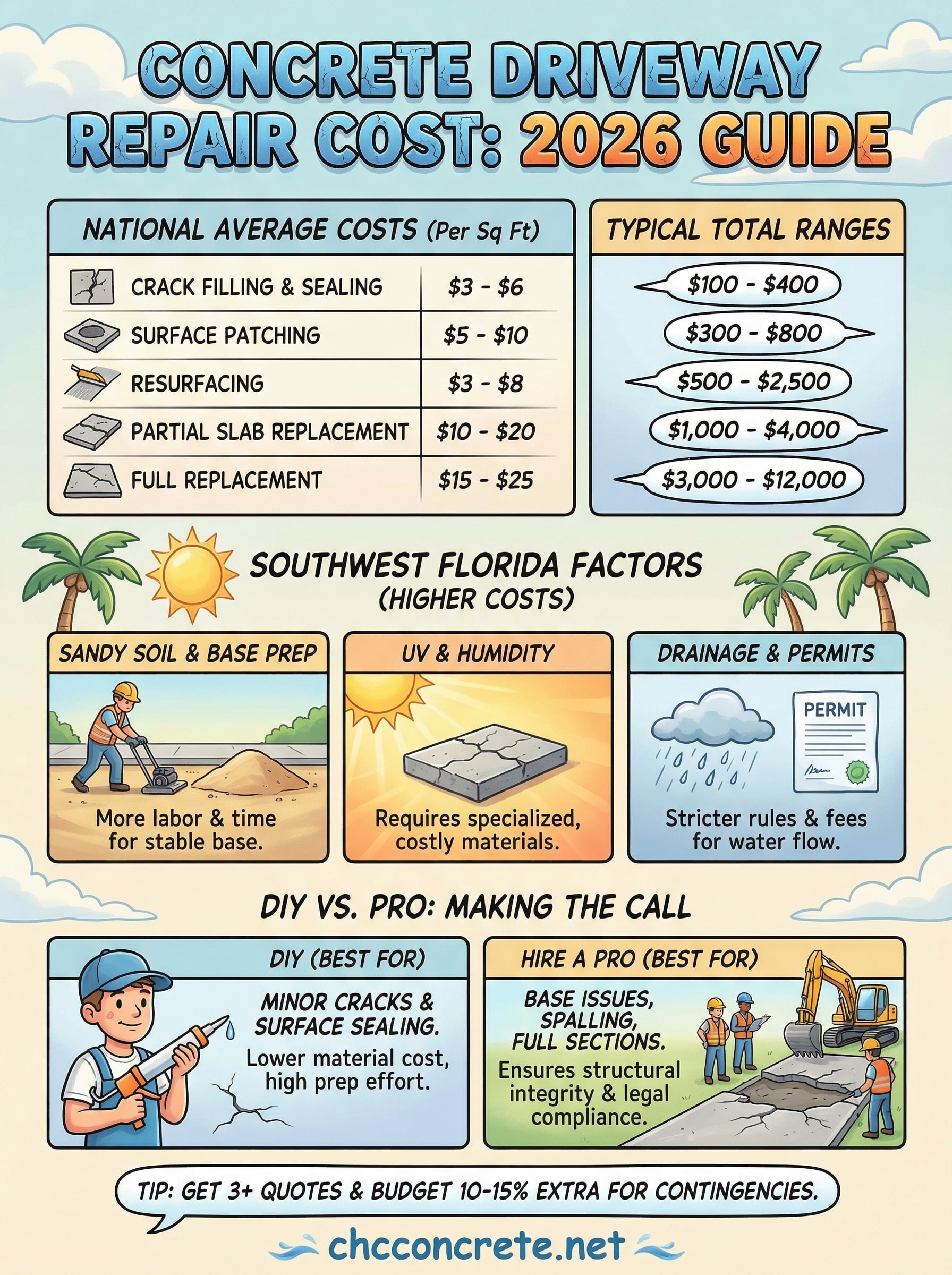
Most repair work breaks into three general tiers based on complexity and material requirements. Surface-level repairs like crack filling and minor patching sit at the lower end, while structural work involving base repair or full section pours sits at the top. Labor typically accounts for 40 to 60 percent of any concrete repair estimate, which is why the same square footage can produce very different quotes depending on local market conditions and the preparation work involved.
| Repair Type | Avg. Cost Per Sq Ft | Typical Total Range |
|---|---|---|
| Crack filling and sealing | $3 to $6 | $100 to $400 |
| Surface patching | $5 to $10 | $300 to $800 |
| Resurfacing | $3 to $8 | $500 to $2,500 |
| Partial slab replacement | $10 to $20 | $1,000 to $4,000 |
| Full driveway replacement | $15 to $25 | $3,000 to $12,000 |
Getting at least three written quotes for any project over $1,000 gives you a much clearer picture of what fair pricing looks like in your local market.
How Florida compares to national rates
Southwest Florida homeowners should expect costs that sit at or above the national midpoint for most repair types. Year-round construction demand, specialized UV- and humidity-rated materials, and the technical base preparation required for sandy soil all push prices slightly higher than the national average. That does not mean you are overpaying. It means the work is being scoped for the conditions your driveway actually faces, which directly affects how long the repair holds.
Permitting requirements in Florida can also add to your total, particularly for larger replacements that alter drainage patterns or extend the existing slab footprint. Your contractor should line-item permit fees in any written estimate so nothing catches you off guard at the final invoice. If a quote omits permitting costs entirely, ask about it before you sign anything.
Cost by problem and repair method
Understanding how repair costs align with specific problems helps you evaluate quotes accurately and avoid paying for scope you don’t need. The concrete driveway repair cost you encounter depends not just on the size of the affected area but on the repair method required to fix it properly. Some problems need surface-level treatment; others require removing concrete entirely and starting over from the base up.
Cracks and surface deterioration
Hairline cracks and minor surface damage represent the lowest cost tier in driveway repair. A contractor fills and seals cracks in the $3 to $6 per square foot range, and most residential jobs in this category come in well under $500 total. The key variable is how wide and deep the crack runs. Cracks under a quarter inch wide generally respond well to polyurethane or epoxy injection, which bonds the concrete back together without full removal.
Spalling falls into a slightly higher cost bracket. That’s when the concrete surface flakes or pits from UV exposure or moisture intrusion over time. Resurfacing a spalled area typically runs $3 to $8 per square foot and involves applying a bonding agent and fresh overlay across the damaged surface. The repair holds well when the base beneath is still structurally sound.
If your crack is widening over time or water pools near it after rain, the problem almost certainly involves the base layer, not just the surface.
Sunken and heaving slabs
Slab settlement happens when the ground beneath the concrete shifts, erodes, or compresses unevenly, causing sections to sink or tilt. Mudjacking or foam injection can lift sunken slabs back into position without full removal, typically costing $5 to $15 per square foot depending on the method used and access requirements. Foam injection tends to cost more upfront but cures faster and adds less weight to the substrate.
When settlement is severe or the slab has cracked into multiple pieces during the shift, lifting alone won’t hold long-term. Full section removal and repour is the appropriate fix in those cases, which lands in the $10 to $20 per square foot range and includes base regrading before new concrete is placed and cured.
Full replacement costs
Replacing an entire driveway is a last resort, but it’s sometimes the most cost-effective path when damage is widespread across the full surface. Costs run $15 to $25 per square foot nationally, and a standard two-car driveway of roughly 400 to 600 square feet puts the total between $6,000 and $15,000 depending on thickness, reinforcement, and finishing requirements.
What drives price in Southwest Florida
The concrete driveway repair cost in Southwest Florida doesn’t follow the same logic as pricing in other parts of the country, and that’s not a coincidence. Soil composition, weather patterns, and local code requirements all push the scope and cost of driveway repairs in ways that homeowners from other regions don’t encounter. Understanding the specific factors at play in Fort Myers, Cape Coral, Estero, and Bonita Springs helps you evaluate local quotes more accurately and understand why some line items exist that you might not see on national pricing guides.
Sandy soil and base preparation
The ground beneath your driveway in Southwest Florida is predominantly sandy, which means it shifts, compresses unevenly, and drains water in unpredictable directions. When a contractor installs or repairs concrete over sandy substrate, proper base compaction and preparation take significantly more time than they would over stable clay or rocky soils found in other states. That additional labor adds cost, but skipping it is exactly what causes slabs to settle, crack, and separate within a few years of installation.
Reputable local contractors account for base preparation in every repair estimate, not just full replacements. If you receive a quote that seems unusually low, ask specifically what base work is included. A cheap pour over uncompacted sandy soil is just a delayed full replacement job.
Base preparation is not optional in Southwest Florida. It’s the difference between a repair that holds for 10 years and one that fails in two.
UV exposure, humidity, and material specifications
Relentless UV radiation and high humidity break down concrete surfaces faster in Southwest Florida than in nearly any other U.S. region. Contractors who work here regularly use mixes and sealers specifically rated for tropical exposure, including products with higher UV resistance and moisture barrier properties. These materials cost more than standard alternatives, and that cost shows up in your quote.
Salt air compounds the issue for properties near the coast or estuaries. Reinforcement materials like rebar and wire mesh need corrosion-resistant coatings in coastal environments, adding another line item that inland projects don’t typically carry.
Drainage and permitting factors
Heavy seasonal rainfall means every driveway project needs to account for how water moves across and away from the repaired surface. Improper drainage slope leads directly to pooling, erosion, and accelerated deterioration. Permitting requirements tied to drainage patterns are also stricter in Florida than in many other states, particularly when a repair or replacement changes how water flows toward neighboring properties or public drainage systems.
DIY vs hiring a pro and how to budget
Deciding between a DIY repair and hiring a licensed contractor comes down to two honest questions: how serious is the damage, and how confident are you in your ability to execute the repair correctly the first time? The concrete driveway repair cost for a failed DIY attempt that needs professional correction always runs higher than what you would have paid to hire someone upfront.
What DIY actually covers
Small crack fills and basic surface sealing are the tasks where DIY makes the most financial sense. Polyurethane or epoxy crack filler kits from a hardware store run $20 to $80, and with proper surface prep, they hold reasonably well on cracks under a quarter inch wide. You save on labor, and the material cost stays low enough that the risk is manageable.
Surface preparation is what separates a lasting DIY repair from one that fails in a season. The crack or damaged area needs to be cleaned, dried, and free of loose material before any filler goes in. Skipping those steps is the most common reason DIY repairs detach within a year. If you commit to the prep work, small surface repairs are well within reach for a motivated homeowner.
DIY concrete repair works well for isolated surface cracks, but anything involving base settlement, widespread spalling, or structural separation needs professional assessment before you spend a dollar on materials.
When professional repair is the right call
Any damage that involves the base layer, multiple cracked sections, or slab settlement falls outside DIY territory for most homeowners. These repairs require proper base regrading, compaction equipment, and concrete mixing at the right ratios for your local conditions. Getting any of those wrong leads to faster deterioration than you had before the repair.
Hiring a licensed and insured contractor also protects you legally and financially if something goes wrong during the project. In Southwest Florida specifically, unpermitted work on drainage-affecting concrete can create liability issues if water runoff damages a neighbor’s property.
How to build an accurate budget
Request at least three written quotes before committing to any project over $500. Each quote should break out labor, materials, base preparation, and permit fees as separate line items so you can compare them accurately. A quote that bundles everything into a single number makes it impossible to understand where cost differences come from.
Set aside 10 to 15 percent above your highest quote as a contingency buffer. Repairs sometimes reveal additional base damage once the old concrete is removed, and having that buffer means work doesn’t stop mid-project while you sort out additional funding.
Next steps
Now you have a solid picture of what concrete driveway repair cost looks like in 2026, from small crack fills to full slab replacement, and you understand the specific factors that shape pricing in Southwest Florida. The next move is straightforward: get a professional assessment of your driveway before the damage spreads and your repair cost grows with it. Surface cracks that cost a few hundred dollars to fix today can turn into base failures that cost several thousand dollars next year.
If your driveway is showing signs of cracking, settling, or surface deterioration anywhere in Fort Myers, Cape Coral, Estero, or Bonita Springs, CHC Concrete is ready to take a look. We provide free on-site estimates with no obligation, and we’ll give you a clear breakdown of what the repair actually involves. Reach out to the concrete repair experts at CHC Concrete and get your project priced accurately before a small problem becomes a major one.