


If you own property in Southwest Florida, chances are you’ve seen sloped yards slowly losing soil after heavy rain, or landscape beds washing out toward driveways and foundations. So what is a retaining wall, and why does it matter for your property? In short, it’s a structure built to hold soil in place where elevation changes would otherwise cause erosion, shifting, or drainage problems. For homeowners in Fort Myers, Cape Coral, Estero, and Bonita Springs, retaining walls aren’t just decorative, they’re a practical solution to real terrain challenges caused by sandy soil and tropical downpours.
At CHC Concrete, we build retaining walls engineered for Southwest Florida’s specific ground conditions. We’ve seen firsthand how poorly planned slopes and drainage can undermine a property’s safety and value over time. That hands-on experience is exactly why we put this guide together, to give you a clear, honest breakdown of how retaining walls work before you commit to a project.
This article covers the different types of retaining walls, what they’re used for, the benefits they offer, and the key factors that affect cost and construction. Whether you’re dealing with a yard that won’t stop eroding or you’re planning a landscaping upgrade, you’ll walk away with the information you need to make a confident decision about your property.
Why retaining walls matter for homeowners
Most homeowners don’t think about soil stability until they spot a problem, a washed-out flower bed, a cracked driveway edge, or a slope that keeps shedding dirt after every rain. In Southwest Florida, sandy soil and heavy seasonal rainfall accelerate these problems faster than most people expect. A retaining wall gives your property a structural defense against the forces that push and pull at your landscape every time a storm moves through. Understanding why these structures matter puts you in a better position to protect your investment before the damage becomes expensive.
How slope and erosion affect your yard
Gravity and water are constantly working on your property. Every time it rains, water moves downhill and carries loose soil with it. In Fort Myers and Cape Coral especially, tropical downpours can drop several inches of rain in just a few hours, which is more than enough to displace significant amounts of soil from unprotected slopes. Over time, that erosion creates low spots in your yard, exposes plant roots, and directs water toward your home’s foundation where it can cause serious structural damage.
A yard that consistently loses soil is not just an aesthetic problem, it’s a structural one that can affect your foundation, drainage system, and overall landscaping investment.
Slope failure rarely happens all at once. Gradual erosion builds quietly, and by the time you notice visible signs like bare patches, cracked pavement, or soft spots near your landscaping beds, the problem has already progressed. A properly built retaining wall interrupts that process by holding soil in place and channeling water toward controlled drainage paths instead of letting it run freely across your yard.
The link between retaining walls and property value
When a buyer or appraiser evaluates your home, visible erosion and drainage issues signal neglected maintenance. A well-built retaining wall signals the opposite: a property managed with intention and care. It adds usable flat space to yards that were previously too sloped to enjoy, which opens real options for patios, garden beds, and outdoor living areas that buyers in Estero and Bonita Springs actively look for.
Structural improvements like retaining walls also protect existing features on your property, including driveways, sidewalks, and landscaping, from being slowly undermined by shifting soil. Each of those features costs money to repair or replace. A retaining wall acts as a buffer that extends their useful life.
So when someone asks what is a retaining wall actually worth to a homeowner, the straightforward answer is: more than most people realize until they’ve watched a slope erode for a few rainy seasons. The cost of building a proper wall almost always runs lower than the cost of repairing the damage that an unmanaged slope eventually causes to surrounding structures, landscaping, and drainage infrastructure. Addressing the problem with a wall from the start is a smarter use of your budget than paying to fix the consequences later.
How retaining walls work with soil and water
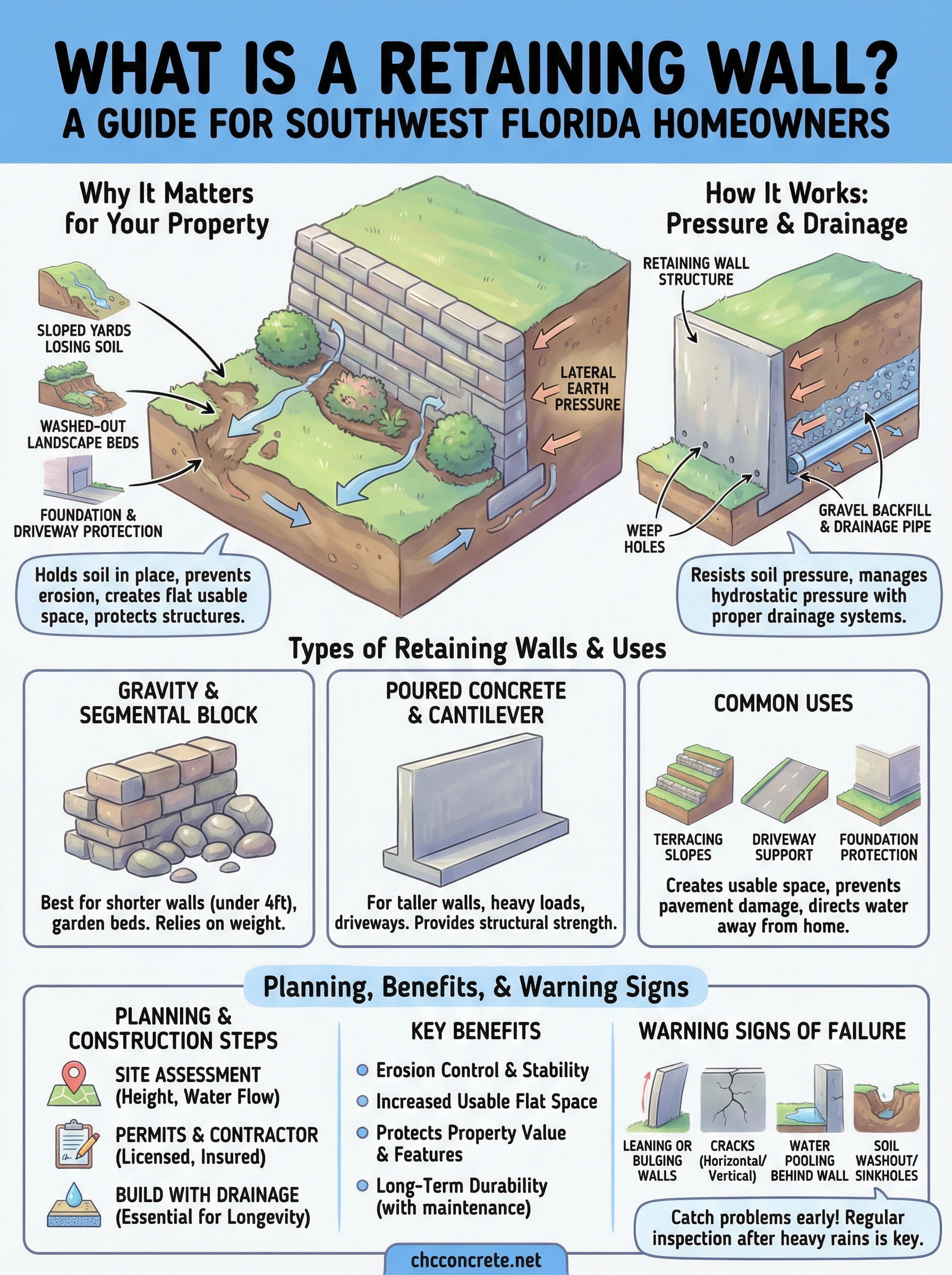
When you ask what is a retaining wall from an engineering standpoint, the answer comes down to pressure management. Soil behind a wall pushes outward constantly, a force called lateral earth pressure, and the wall’s job is to resist that push without cracking, shifting, or tipping. The heavier and wetter the soil, the more pressure it generates. In Southwest Florida, where sandy soil absorbs water quickly and tropical rains arrive in concentrated bursts, that pressure can build fast and intensify in ways that catch unprepared homeowners off guard.
The forces acting on a retaining wall
Soil doesn’t push with equal force in every direction. The pressure is greatest at the base of the wall and decreases toward the top, which is why retaining walls are typically built thicker at the bottom or rely on reinforcement techniques like tiebacks and deadmen anchors embedded deep into the soil behind them. Engineers also account for surcharge loads, meaning the extra weight of anything sitting on top of the retained soil, such as a driveway, a parked vehicle, or saturated ground after a heavy rain. Ignoring those forces is one of the most common reasons walls fail prematurely.
A wall built without accounting for surcharge loads and hydrostatic pressure isn’t a long-term fix. It’s a structure waiting to fail.
How drainage is built into the wall
Water is often the primary reason a retaining wall collapses. When water saturates the soil behind a wall and has nowhere to go, the pressure it generates, called hydrostatic pressure, can overwhelm even a well-built structure. That’s why drainage isn’t an afterthought. Properly constructed retaining walls include drainage solutions built directly into the design, such as:
- Gravel backfill placed behind the wall to promote water movement away from the soil mass
- Perforated drainage pipes routed along the base to carry water out and away from the structure
- Weep holes in concrete or masonry walls that allow trapped water to escape before pressure builds
Your wall’s long-term performance depends heavily on how well this drainage layer functions during heavy rainfall. Without it, even a structurally sound wall can develop cracks and begin to lean as saturated soil pushes harder than the structure was designed to handle throughout Southwest Florida’s rainy season.
Types of retaining walls and when to use each
Not every retaining wall is built the same way, and understanding the differences helps you choose the right structure for your site conditions and budget. When people ask what is a retaining wall in practical terms, part of the answer depends on the material and method used to build it. Each type handles soil pressure and drainage differently, and the best choice for your property depends on factors like wall height, soil type, and the load placed on the retained area.
Gravity and segmental block walls
Gravity walls work by using their own weight to resist soil pressure. These include stacked stone, concrete block, and interlocking segmental units that lock together without requiring deep footings or complex reinforcement. They work well for shorter walls under four feet and garden-level grade changes where the soil load stays moderate. Segmental block walls are especially popular in Southwest Florida because the individual units tolerate minor soil movement without cracking the way solid poured concrete can.
Segmental block walls are one of the more forgiving options for sandy Florida soil, but they still require proper base compaction and drainage to hold up through rainy season.
Poured concrete and cantilever walls
Poured concrete walls are the go-to choice when you need structural strength for taller or heavily loaded applications, such as walls supporting a driveway or retaining soil next to a building foundation. A cantilever wall uses an L-shaped footing that extends beneath the retained soil, letting the weight of that soil help stabilize the structure from below. These walls require more planning, reinforcement, and permitting, but they deliver reliable long-term performance when the load and height demand it.
The table below gives you a quick comparison to match each wall type to a realistic use case:
| Wall Type | Best For | Key Limitation |
|---|---|---|
| Gravity/block | Short garden walls | Limited to lower heights |
| Segmental block | Residential landscaping | Needs proper base prep |
| Poured concrete | Heavy loads, taller walls | Higher cost and permitting |
| Timber | Low-budget, low-height walls | Deteriorates over time in Florida’s humidity |
| Sheet pile | Tight spaces, soft or wet soil | Less visual appeal |
Common retaining wall uses around a home
Once you understand what is a retaining wall and how it holds soil in place, the next question is where it actually fits on a residential property. The answer varies more than most homeowners expect. Retaining walls show up in several different applications around a home, and each one solves a specific problem rather than just adding visual interest to a yard.
Terracing sloped yards and garden beds
One of the most frequent uses for a retaining wall is converting a sloped yard into flat, usable space. In Southwest Florida, many residential lots have gradual grade changes that make outdoor furniture, patios, and play areas impractical without leveling the ground first. A series of shorter walls built in steps, called terracing, breaks a long slope into multiple flat tiers that you can use for garden beds, grass, or paved outdoor areas.
Terracing a slope doesn’t just create usable space. It also dramatically slows erosion by shortening the distance water travels before hitting a flat surface.
Raised garden beds built against retaining walls give you better drainage control for plants. Sandy Florida soil drains too fast for many plants, and a contained raised bed lets you bring in better growing medium and keep it in place without watching it wash downhill every rainy season.
Supporting driveways and walkways
Driveways and sidewalks built near a grade change need lateral support to stay stable over time. Without a wall holding the adjacent soil back, the soil edge erodes and the pavement eventually cracks and sinks at the edges. A retaining wall installed alongside a driveway keeps the soil profile intact, which protects the concrete slab from losing its base and developing costly cracks.
Walkways leading from a street to a front door often cross small but significant grade changes. A low retaining wall on one or both sides keeps the path safe, defined, and visually clean while preventing the surrounding landscaping from sliding onto the walking surface after heavy rain.
Protecting areas near your home’s foundation
Soil that slopes toward your foundation creates a direct path for water to pool against the base of your home. A retaining wall positioned to redirect that flow keeps hydrostatic pressure away from your slab or stem wall and reduces the risk of moisture intrusion over time.
Benefits and drawbacks to know before you build
Before committing to a construction project, knowing what you’re getting into on both sides of the ledger helps you plan with clear expectations. When homeowners ask what is a retaining wall actually worth building, the answer depends on your specific site conditions and whether the benefits outweigh the upfront cost and maintenance responsibilities. For most properties in Southwest Florida, the math works out in favor of building, but that doesn’t mean there are no real trade-offs to weigh carefully.
Benefits that go beyond holding soil
A retaining wall delivers more than erosion control. When built correctly, it creates flat, usable outdoor space on previously sloped or unusable portions of your property. That directly expands how you can use your yard and adds tangible value to your home. In a market like Fort Myers or Cape Coral, outdoor living space is a strong selling point, and a well-designed terraced yard with a solid retaining wall signals quality construction to prospective buyers.
A properly drained and reinforced retaining wall can last 25 to 50 years with minimal maintenance, making it one of the more durable investments you can make in your property.
Retaining walls also protect other features on your property. Driveways, sidewalks, and landscaping near grade changes all stay more stable and last longer when adjacent soil is held securely in place rather than allowed to shift and erode season after season in Florida’s rainy climate.
Drawbacks to factor into your planning
The most significant drawback is upfront cost. Poured concrete and engineered walls require materials, labor, drainage systems, and often permits, all of which add up quickly. Cutting corners on any of those steps typically leads to premature failure and repair costs that exceed what a proper build would have cost from the start.
Maintenance is another factor. Even a well-built wall needs periodic inspection, especially after heavy rain. Drainage components can clog, weep holes can back up, and block walls can shift slightly if the base wasn’t prepared to the right depth. Catching these issues early keeps minor corrections from turning into full wall replacement. Building it right the first time and checking it annually is the most cost-effective approach for any homeowner.
How to plan a retaining wall project step by step
Planning is where most retaining wall projects succeed or fail before a single shovel hits the ground. If you’ve been asking what is a retaining wall and whether your property actually needs one, the planning phase is where you answer that question with real data. Getting the scope, drainage design, and permitting right upfront saves you from costly corrections once construction is underway.
Assess your site and define the scope
Start by measuring the height and length of the slope you need to hold back. Walls taller than four feet require engineered plans and permits in most Florida municipalities, so that threshold matters immediately. Walk the area during or after a heavy rain and note where water pools, where soil shifts, and how water exits your property. That observation gives your contractor the drainage information needed to design a wall that performs through rainy season rather than failing because of it.
The details you gather in the site assessment phase directly determine whether your wall holds for decades or starts leaning within a few years.
Once you’ve mapped the area, identify what sits behind and above the proposed wall, including driveways, structures, or mature landscaping with significant root and soil weight. Surcharge loads from those features affect the required wall thickness and reinforcement. A contractor who skips that calculation is leaving your project vulnerable from the start.
Work through permits and contractor selection
Pull permits before any work begins. In Fort Myers, Cape Coral, and surrounding municipalities, retaining walls above a certain height require a building permit and inspections. Skipping that step can result in fines, forced removal, and complications when you eventually sell your home. Your contractor should know local permitting requirements and handle that process as part of the job, not leave it entirely on you.
When evaluating contractors, verify their license and insurance directly with the Florida Department of Business and Professional Regulation. Ask for references from completed wall projects and confirm that each proposal specifically includes drainage components like gravel backfill and a perforated drain pipe at the base. Any quote that skips drainage details entirely is worth questioning before you sign anything.
Warning signs of a failing retaining wall
Knowing what is a retaining wall also means knowing when one is no longer doing its job. Walls don’t usually collapse without warning, and catching early signs of distress gives you time to make targeted repairs before you’re facing a full replacement. In Southwest Florida, where heavy rains and sandy soil put constant stress on these structures, a quick inspection after every major storm can save you thousands of dollars in damage down the road.
Visible structural changes to watch for
The most obvious warning signs show up in the wall itself. Leaning or bulging sections are a red flag that lateral soil pressure has started to overcome the wall’s resistance, either because drainage has failed, the base has shifted, or the structure was undersized for the load behind it. Horizontal cracks near the base of the wall are especially serious because that’s where pressure is highest.
A wall that leans more than one inch out of plumb for every four feet of height needs professional evaluation immediately, not at the end of the season.
Vertical cracks running the full height of a block or concrete wall typically indicate foundation movement or settling. Separated joints in segmental block walls, where individual units have visibly shifted out of alignment, signal that the wall’s interlocking system is no longer holding together under load.
Drainage and surface clues
Drainage problems often show up away from the wall itself. If you notice water pooling directly behind your wall rather than draining away after rain, the drainage system behind it is likely clogged or was never installed correctly. That standing water builds hydrostatic pressure that accelerates wall failure faster than almost any other factor.
Soil washing out from behind or beneath the wall is another clear warning sign. When you see bare gaps opening up at the base or sides of the wall, the retained soil is actively escaping, which means the wall has already lost part of its foundational support. On the surface above the wall, soft spots, sinkholes, or uneven settling in a nearby driveway or path indicate that the soil profile behind the wall is shifting in ways that will compromise the structure if left unaddressed.
Next steps for your property
Now that you understand what is a retaining wall and how it functions, the next move is to evaluate your own property with that knowledge in hand. Walk your yard after the next heavy rain and look for the warning signs covered in this guide: soil washing toward your foundation, water pooling behind existing structures, or slopes that keep losing ground season after season. Those observations give you a clear starting point for a conversation with a contractor before small problems turn into structural ones.
If you’re in Fort Myers, Cape Coral, Estero, or Bonita Springs, CHC Concrete offers free on-site estimates and brings direct experience with Southwest Florida soil conditions, drainage requirements, and local permitting. Getting a professional set of eyes on your property costs you nothing upfront and gives you specific recommendations your site actually needs before the damage gets expensive to fix.