


Getting the answer to how thick should a concrete patio be matters more than most homeowners realize, because once that concrete is poured, you’re living with the result for decades. Go too thin, and you’ll deal with cracking, settling, and costly replacements far sooner than you should. Go thicker than necessary, and you’ve spent money you didn’t need to.
The standard answer is 4 inches for most residential patios, but that number changes fast when you add a hot tub, outdoor kitchen, or heavy furniture to the equation. Soil conditions play a major role too, especially here in Southwest Florida, where sandy ground and heavy rainfall create challenges that other regions don’t face.
At CHC Concrete, we pour patios across Fort Myers, Cape Coral, Estero, and Bonita Springs, and thickness is one of the first things we evaluate on every project. This article breaks down when 4 inches is enough, when you need to step up to 6, and what factors, from load weight to soil prep, should drive that decision. We’ll also cover reinforcement, base preparation, and the specific conditions in Southwest Florida that affect how your patio performs over time.
What patio thickness means in real life
When contractors talk about patio thickness, they mean the vertical depth of the concrete slab from the finished surface down to the base material beneath it. That measurement is taken at multiple points across the slab, not just at one edge, because uneven depth across a pour creates weak spots that crack under load or temperature stress. You can have a beautifully finished surface that still fails in five years if the depth isn’t consistent throughout the slab.
Why thickness controls load capacity
The thickness of your slab is directly tied to how much weight it can support before it flexes or cracks. Concrete handles compression well but handles tension poorly, which means that when a load causes the slab to flex downward in the middle, the bottom of the slab is under tension, and that’s where cracks originate. A thicker slab resists that flex, giving the concrete a better chance of distributing load across a larger cross-section rather than concentrating stress in one spot.
Moving from a 4-inch to a 6-inch slab doesn’t just add 50% more material; it significantly increases the slab’s resistance to bending and load-related cracking.
How thickness interacts with the ground beneath
Your patio slab doesn’t perform in isolation. It sits on top of a compacted base layer, typically gravel or crushed stone, and the quality of that base affects how the slab behaves under load. If the base shifts, settles, or washes out, the slab loses support from below, and even a properly thick pour can crack when the ground beneath it moves.
Understanding how thick a concrete patio should be requires looking at the full picture: the slab depth, the base material, and what you plan to place on top of it. Reinforcement, such as rebar or wire mesh, adds a third layer to that equation by helping the slab hold together if the ground beneath it shifts. Thickness and preparation work together, and cutting corners on one will undermine the other regardless of how well the rest of the job is done.
When a 4-inch patio slab works
A 4-inch slab is the industry standard for most residential concrete patios, and it holds up well when conditions work in your favor. If you’re pouring a patio for standard outdoor furniture, foot traffic, and casual use, 4 inches gives you enough depth to handle those loads without overbuilding.
The right conditions for a 4-inch pour
Your 4-inch patio works when the ground beneath it is stable and properly compacted, and when the planned use stays within typical residential activity. Thinking about how thick should a concrete patio be starts with asking what you’ll actually place on that surface. If the answer is lawn chairs, a grill, and a dining set, 4 inches is the right call.
A 4-inch slab on a well-prepared base handles standard residential patio loads reliably when paired with proper reinforcement.
For this thickness to perform over the long term, a few conditions need to be in place:
- Base preparation of at least 4 inches of compacted gravel beneath the slab
- Wire mesh or rebar installed before the pour to reinforce the slab
- No heavy concentrated loads, such as hot tubs, heavy planters, or vehicle weight
- Stable, well-draining soil that won’t shift or wash out under the slab
These conditions are common on well-graded residential lots, which is why 4 inches covers the majority of standard backyard patios across the country.
When you need 6 inches or more
Some patios carry loads that a 4-inch slab simply isn’t built for. When you add significant concentrated weight or build over unstable ground, stepping up to 6 inches is the practical choice, not an upgrade. Knowing how thick should a concrete patio be in these situations can save you from an expensive replacement.
Heavy loads change the calculation
Hot tubs are the most common reason residential patios need a thicker slab. A filled hot tub can weigh between 3,000 and 5,000 pounds, and that weight sits on a small footprint rather than spreading across the full slab. Outdoor kitchens, large stone planters, and heavy grills create similar concentrated stress points. A 4-inch slab flexes under that kind of load, and flexing leads to cracking at the bottom of the slab where tension builds.
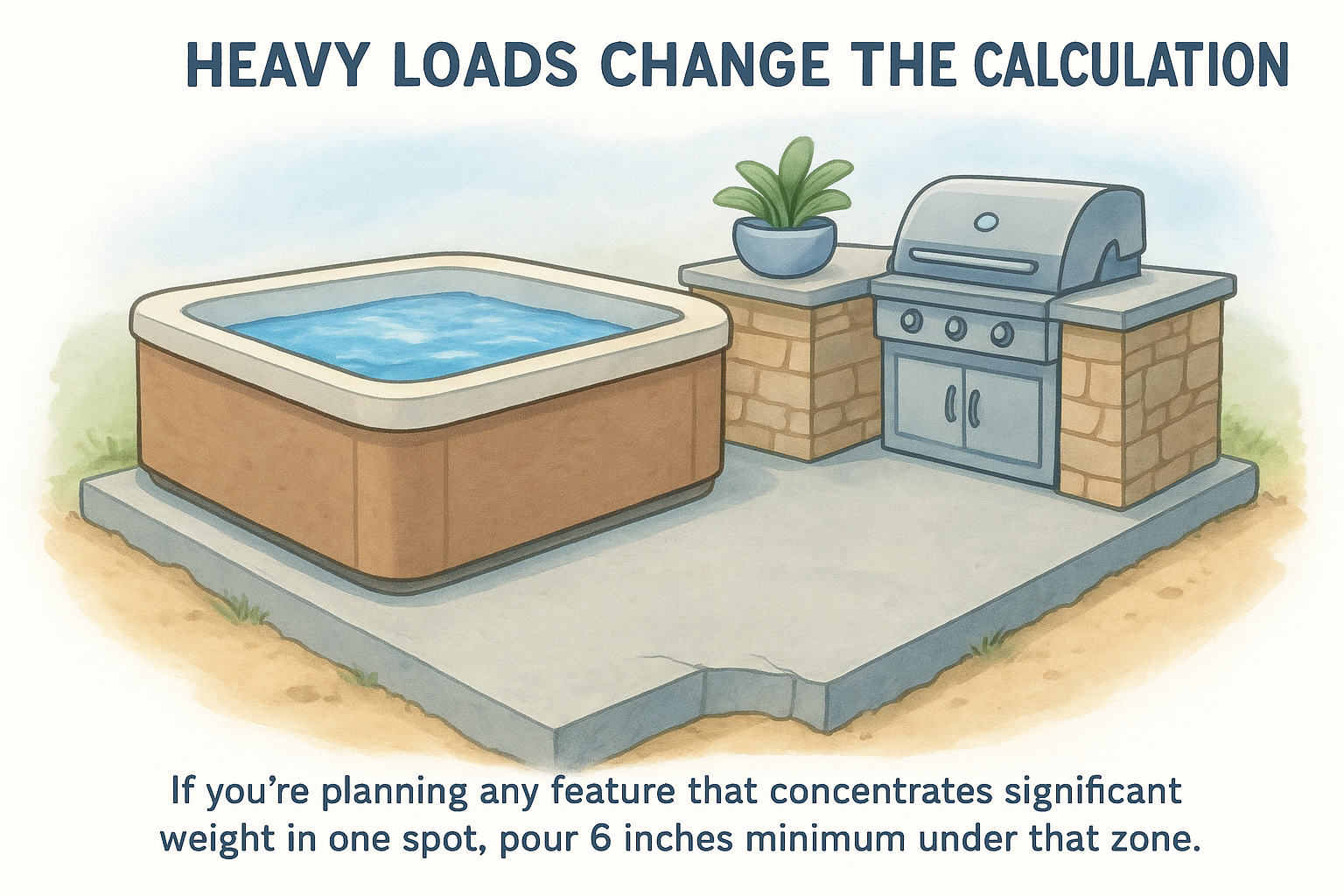
If you’re planning any feature that concentrates significant weight in one spot, pour 6 inches minimum under that zone.
For these situations, use 6-inch depth paired with rebar instead of wire mesh, since rebar provides better tensile reinforcement where loads are concentrated.
Poor soil conditions require more depth
Soft, sandy, or poorly draining soil reduces the support the ground provides to your slab. When the base material shifts or erodes, a thinner slab loses structural integrity faster. Going to 6 inches gives the slab more mass to bridge gaps in support, reducing the risk of settlement cracks forming across your patio over time.
What matters as much as slab thickness
When you ask how thick should a concrete patio be, thickness is only part of the answer. Two patios poured at the same depth can perform very differently depending on what’s underneath and inside the slab. Skipping proper prep on either front turns a well-designed pour into a liability.
Base preparation
The base layer is what your slab actually rests on, and it does more work than most homeowners expect. A minimum 4-inch layer of compacted gravel beneath your patio gives the slab stable, well-draining support that resists shifting when rain saturates the ground. Without it, even a thick slab develops settlement cracks as the soil beneath it moves unevenly.
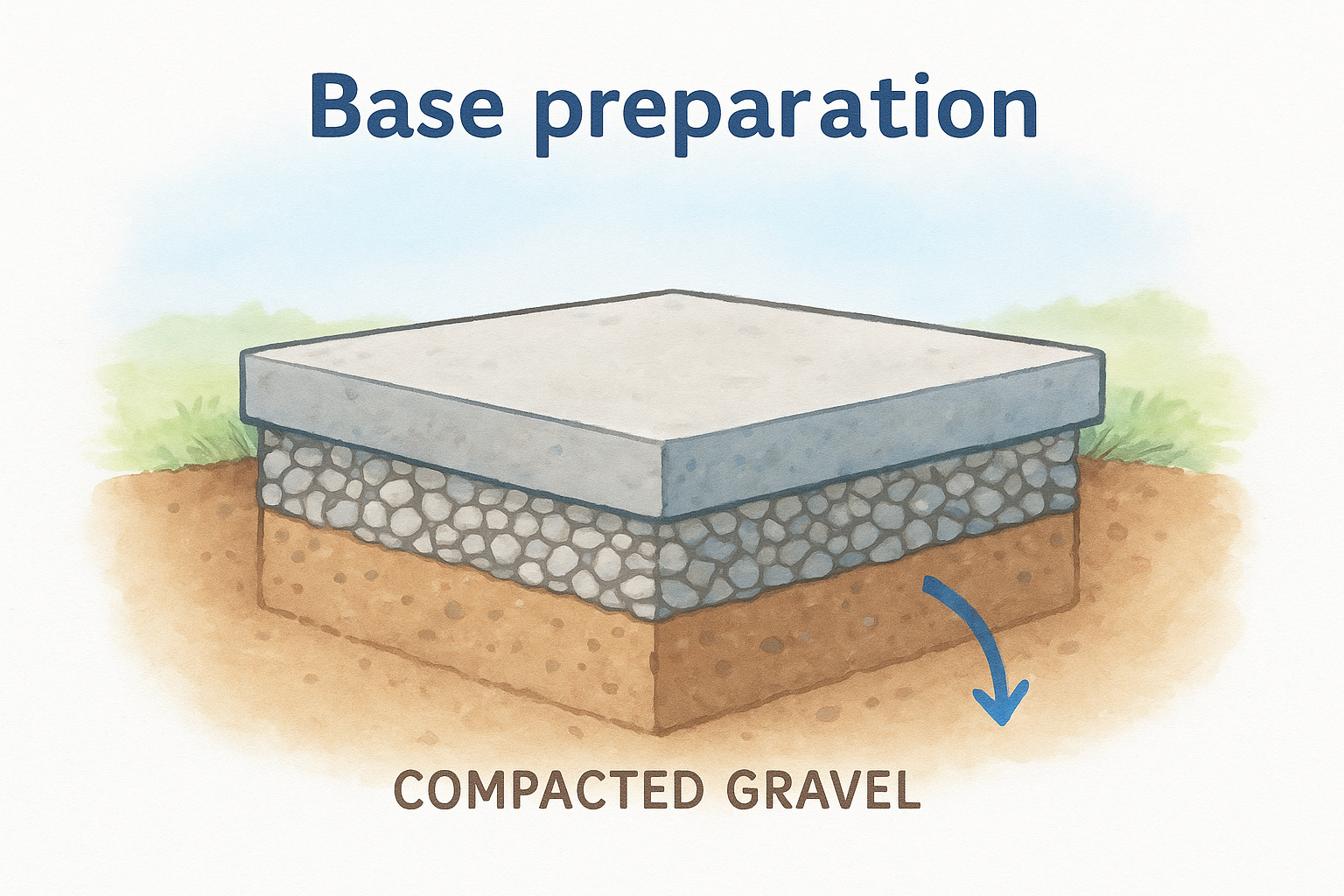
Proper base prep prevents more patio failures than any increase in slab thickness alone.
Compaction matters just as much as the material itself. Loose or poorly graded fill settles at different rates across the slab, which creates voids the concrete has to bridge. Those voids become cracking points under load.
Reinforcement inside the slab
Reinforcement keeps your slab together when stress develops inside it. Wire mesh works for standard residential patios, but rebar gives you more reliable tensile strength under concentrated loads like hot tubs or heavy outdoor kitchens. The reinforcement needs to sit at the correct height inside the pour, roughly centered or slightly below center, so it’s positioned where tension actually develops when the slab flexes.
Southwest Florida patio thickness notes
Southwest Florida soil behaves differently from the compacted clay and loam common in other parts of the country. When you’re asking how thick should a concrete patio be in Fort Myers, Cape Coral, or Bonita Springs, you need to factor in loose sandy soil, high water tables, and tropical rainfall that can saturate and shift your base material far faster than in drier climates.
Sandy soil demands more base prep and often more depth
The sandy soil throughout Southwest Florida drains quickly in light rain but moves and redistributes during heavy tropical downpours and storm surge events. That movement undermines base layers that would otherwise stay stable in northern climates. For most residential patios in this region, a 4-inch slab is still workable, but only when the contractor installs a deep, well-compacted gravel base and includes reinforcement throughout the entire pour.
In Southwest Florida, cutting base depth to save money creates far more risk than elsewhere because the soil gives you less natural support to start with.
Heat and UV exposure affect long-term slab performance
Florida’s intense UV exposure and surface temperatures cause concrete to expand and contract more aggressively than in moderate climates. A slab poured at the correct thickness with proper control joints manages that movement without surface cracking. Thinner slabs have less mass to buffer that thermal stress, which is one more reason to hold the line at 4 inches minimum and step up without hesitation when any load or soil concern justifies it.
Final takeaway
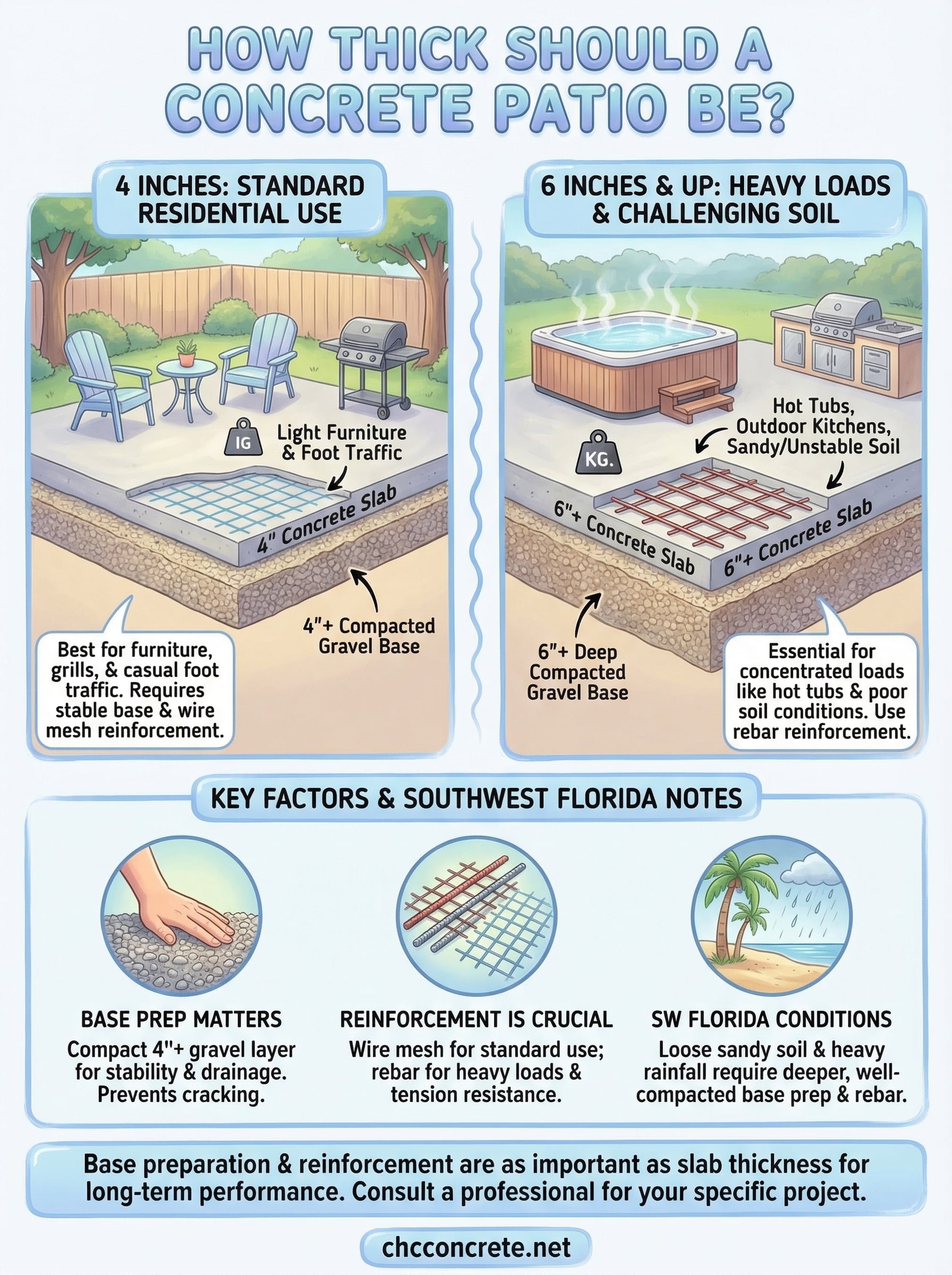
The answer to how thick should a concrete patio be comes down to what you’re building and what’s underneath it. For most residential patios with standard furniture and foot traffic, 4 inches on a properly compacted gravel base gets the job done. Add a hot tub, outdoor kitchen, or any concentrated heavy load, and 6 inches with rebar is the right call, not an upgrade.
Base prep and reinforcement carry just as much weight as the slab depth itself. Cutting corners on either one undermines even a well-proportioned pour. In Southwest Florida specifically, sandy soil and heavy rainfall make proper base preparation more critical than it is in most other regions, so don’t treat it as optional.
If you’re planning a patio in Fort Myers, Cape Coral, Estero, or Bonita Springs, contact CHC Concrete for a free on-site estimate and straightforward advice on what your specific project actually needs.